

Manual vs Electric Grinders for Pour Over
Table of Contents
- Manual vs Electric Grinders: What Sets Them Apart
- Speed and Efficiency in Your Morning Routine
- Grind Consistency and Quality for Pour Over Extraction
- Best Burr Grinder for Pour Over: Choosing Your Mechanism
- Coffee Grind Size for Pour Over: Getting the Right Particle Distribution
- Benefits of Hand Grinding Coffee
- Price, Maintenance, and Long-Term Value
- Which Grinder Fits Your Pour Over Workflow
- Frequently Asked Questions
Last Updated: October 2, 2026
Manual vs Electric Grinders: What Sets Them Apart
When you're serious about pour-over coffee, your grinder matters more than your brewer. The difference in manual vs electric grinders for pour over isn't just speed, it's about grind consistency, heat generation, and how much control you actually have over extraction.
At Cenia's Coffee, we've watched home brewers struggle with this choice for years. The answer depends on your workflow, your patience, and what "perfect" means to you. Manual grinders offer something electric models often can't: precise control and lower heat. Electric grinders trade that control for speed and convenience. Neither is universally better. Both solve real problems.
Here's what matters: pour-over extraction is brutally sensitive to grind uniformity. Fines (tiny particles) over-extract and make coffee bitter. Boulders (large chunks) under-extract and make it sour. The grind size distribution, how evenly your beans break apart, determines whether your cup tastes bright or muddy.
Speed and Efficiency in Your Morning Routine
Manual grinders take time. Depending on the grinder and your bean quantity, expect 5-15 minutes of hand grinding for a single cup. That's not a flaw for some people, it's the ritual. For others, it's a dealbreaker.
Electric grinders handle the same job in 30-60 seconds. If you're grinding fresh every morning before work, that speed compounds. Over a year, an electric grinder saves you roughly 40-50 hours of grinding time.
The trade-off: electric grinders generate heat during grinding, which can slightly warm the beans. Manual grinding produces almost no heat, preserving volatile aromatic compounds that make pour-over coffee taste alive. For single-origin, light-roasted beans where flavor clarity matters most, that difference is audible in the cup.
Speed also affects workflow integration. If you grind while water heats, an electric grinder fits seamlessly. Manual grinding requires deliberate time carved out, which some brewers see as meditative, others as friction.
Grind Consistency and Quality for Pour Over Extraction
This is where the mechanics matter. Burr grinders, both manual and electric, break beans between two abrasive surfaces. The distance between those burrs determines grind size. How evenly those burrs are spaced determines consistency.
Manual grinders typically use conical burrs. These sit inside each other like nested cones, and as you turn the handle, beans drop between them and get crushed. Conical burrs are forgiving.
Electric grinders come in two flavors: conical and flat. Flat burrs sit horizontally and spin against each other. They produce slightly more uniform grind distribution than conical burrs, especially at finer settings.
The catch: flat burrs in electric grinders also generate more heat and tend to retain more spent grounds (retention). That matters less if you're grinding daily, but it's worth knowing.
Best Burr Grinder for Pour Over: Choosing Your Mechanism
The best burr grinder for pour over depends on understanding how burr geometry directly influences extraction uniformity and brew time. This is where most articles stop at "flat vs. conical", but the real lever is burr diameter and cutting surface area.
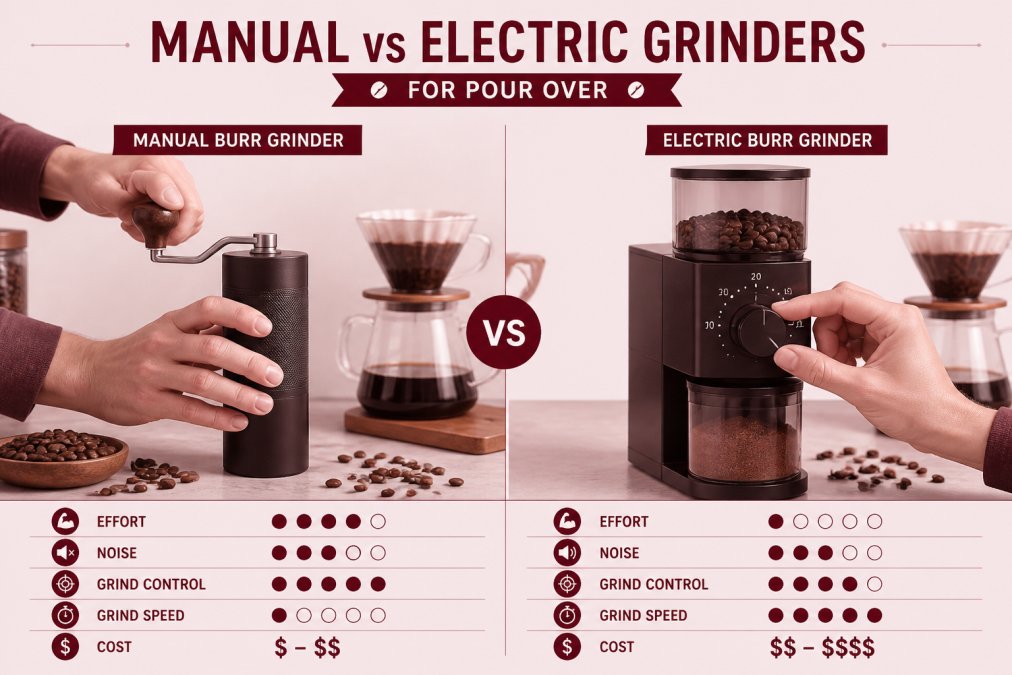
Manual grinders typically use conical burrs with diameters between 38-50mm. Larger burr diameters (45-50mm) produce more consistent particle size distribution because the cutting surfaces have more surface area and apply more gradual pressure as beans move through.
Electric grinders with flat burrs typically range from 40-55mm in diameter. Flat burr geometry matters because the horizontal orientation means beans spend less time between the burrs, they're cut rather than crushed. This produces tighter particle uniformity, especially in the 0.75-1.0mm range that pour-over demands.
For pour-over specifically, burr geometry interacts with grind size adjustment precision.
Conical burrs also perform better across a wider range of grind sizes. If you're brewing both V60 (which prefers slightly finer grinds around 0.9mm) and Chemex (which prefers coarser around 1.2mm) on the same grinder, a well-engineered conical burr manual grinder adapts more smoothly to both without requiring major recalibration.
Conical vs Flat Burr Performance
Conical burrs crush beans more gradually, which means less heat and less noise. They're the standard in manual grinders because they're simple and effective. Flat burrs grind faster and produce slightly tighter particle uniformity, but they run hotter and louder.
For pour-over specifically, the difference is real but not dramatic. A well-designed conical burr manual grinder will produce grind consistency good enough for excellent extraction. A flat burr electric grinder will be marginally more consistent. The gap narrows when you factor in user skill, dialing in a manual grinder with poor technique beats dialing in an electric grinder perfectly.
The practical trade-off: if you're grinding the same beans at the same size every morning, flat burr electric grinders deliver more predictable results. If you're experimenting with different pour-over methods or bean origins that require grind adjustments, conical burr manual grinders offer more control and less waste from retention.
Coffee Grind Size for Pour Over: Getting the Right Particle Distribution
Pour-over grind size sits in the middle of the spectrum, coarser than espresso, finer than French press. Most pour-over brewers target a grind size roughly equivalent to sea salt or fine sand.
The real skill isn't hitting that size. It's hitting it consistently. If your grinder produces 80% particles at the right size and 20% fines plus boulders, your brew will be uneven. The fines will extract too fast. The boulders will extract too slow. You'll taste both, muddy and sour at once.
This is where grind size distribution matters more than average grind size. A manual grinder with tight burr geometry might produce better particle uniformity than an electric grinder with loose burrs, even if the average size is identical. Retention also factors in: if your electric grinder holds old grounds, mixing fresh and stale particles ruins consistency.
Benefits of Hand Grinding Coffee
Manual grinding forces you to slow down. That's not romantic fluff, it's a real advantage. When you grind by hand, you develop tactile feedback. You feel when the beans are fully broken. You notice texture changes that signal burr wear or misalignment. You can't automate your way past attention.
Hand grinding also means zero electricity and minimal noise. If you live in a small space or have early mornings, a manual grinder won't wake anyone. The ritual itself, the repetitive motion, the sound of beans cracking, appeals to people who see brewing as practice, not just caffeine delivery.
Maintenance is simpler too. Manual grinders have fewer moving parts. No motor means no motor failures. Burr replacement is straightforward. For someone who wants to own their tools rather than replace them, a manual grinder is the better long-term bet.
Price, Maintenance, and Long-Term Value
Manual grinders cost less upfront, typically $30-$80 for a quality burr grinder.
A quality manual grinder lasts 10-20+ years with basic care. Burr replacement, when needed, costs $15-$40 depending on the model.
Motor failure is the primary failure mode for electric grinders.
Burr wear affects both types equally. Burrs dull after 500-1000 pounds of grinding, depending on bean density and grind fineness.
Retention, the amount of ground coffee that sticks inside the grinder, adds a hidden cost. Manual grinders typically retain 0.2-0.5 grams per grind.
Electricity cost is negligible. A typical electric grinder uses 100-150 watts for 45 seconds per day, costing roughly $0.50-$1.00 per year.
Your time has measurable value too. If you grind daily, a manual grinder costs 5-15 minutes per session.
Maintenance costs favor manual grinders. Cleaning is simpler. Replacement burrs are cheaper. You're not paying for electricity.
Which Grinder Fits Your Pour Over Workflow
The choice comes down to three questions: How much time do you have? How much consistency do you need? How long do you want to keep your grinder?
If you grind fresh daily and value ritual, a manual grinder with conical burrs fits.
If you grind multiple times daily or value speed and precision above all, an electric grinder with flat burrs makes sense. You'll get marginally better particle uniformity, save time, and have a more predictable grind every morning.
Neither choice is wrong. Both produce excellent pour-over coffee. The difference is in how you want to spend your morning and what you're willing to invest upfront.
When you pair the right grinder with fresh-roasted beans from Cenia's Coffee, beans roasted to order to preserve the flavor clarity that pour-over demands, you unlock what manual or electric grinding can actually achieve.
Frequently Asked Questions
Are manual coffee grinders better than electric for pour over?
Neither is universally better, it depends on your priorities. Manual grinders excel at producing uniform particle size and generating less heat, which preserves flavor complexity. Electric grinders are faster and require minimal physical effort. For pour over, consistent grind size matters most, so a manual grinder with quality conical burrs often produces better extraction, while a burr-equipped electric grinder offers speed without sacrificing much consistency.
What coffee grind size works best for pour over brewing?
Pour over typically requires a medium grind, similar in texture to sea salt. The exact size depends on your brew method: pour-over cones like Melitta prefer slightly finer grinds (medium-fine), while flat-bottomed drippers work well with medium. Grind too coarse and water flows through too quickly, resulting in under-extraction and weak coffee. Too fine and the brew becomes over-extracted and bitter. Quality burr grinders, whether manual or electric, allow precise adjustment to dial in the right size for your specific dripper.
Do electric grinders produce more heat than manual grinders?
Yes, electric burr grinders generate more heat due to motor friction and higher RPM. Excessive heat can damage delicate flavor compounds in freshly roasted beans. Manual grinders produce minimal heat because they operate at low speeds with direct hand control, making them ideal for preserving the nuanced flavors in specialty coffee. If you use an electric grinder, let beans cool for a few minutes after grinding, or choose a grinder with low RPM and thermal management features.
How long does it take to manually grind coffee for a pour over?
Grinding a single dose (about 20-30 grams for one cup) typically takes 3-5 minutes with a quality manual grinder, depending on burr design and grind fineness. Coarser grinds finish faster; finer grinds take longer. While this requires more time than an electric grinder (which takes 20-30 seconds), many coffee enthusiasts view the ritual as part of the brewing experience. For remote professionals on a flexible schedule, the slower pace can actually encourage a more intentional morning routine.
Choosing between manual and electric grinders for pour over isn't about picking a winner. It's about matching your grinder to your workflow and your values. Cenia's Coffee delivers fresh-roasted beans optimized for pour-over brewing, so your grinder choice becomes about control, speed, and consistency rather than bean quality. Whether you hand-grind or use electric power, start with beans roasted to order for maximum flavor and aroma.