

Is Buying Coffee in Bulk Worth It? A Cost Analysis
Table of Contents
- The Real Math: Cost Per Ounce Analysis
- Coffee Bean Shelf Life After Roasting
- How to Store Coffee Beans for Maximum Freshness
- Best Coffee Beans for Home Brewing
- Bulk Buying Pros and Cons
- When Bulk Buying Makes Financial Sense
- Subscription vs. Bulk: Which Fits Your Routine
Last Updated: August 28, 2026
The Real Math: Cost Per Ounce Analysis
Buying coffee in bulk is worth it only if you actually use it before it loses peak flavor. A typical 12-ounce bag of specialty coffee costs $12-$18 retail ($1-$1.50 per ounce), while a 5-pound bulk bag drops the per-ounce cost by 15-25%. But this savings vanishes if you consume the coffee after it loses quality.
Coffee beans begin losing aromatic compounds and flavor within two to four weeks of roasting (peer-reviewed research). The real cost per ounce must include a "freshness factor", if you consume a pound every two weeks, bulk buying makes sense. If you go through a quarter pound per week, smaller frequent purchases preserve quality better.
A practical approach: calculate your daily coffee consumption in ounces, multiply by 14 (two weeks), and that's your ideal bulk purchase size. At Cenia's Coffee, we encourage customers to match order size to actual consumption timeline, not by buying the largest quantity available.
Coffee Bean Shelf Life After Roasting
Coffee beans have a flavor window, not a single expiration date. Freshly roasted beans reach peak flavor between 5 and 14 days after roasting, when CO2 release stabilizes and flavor compounds are most vibrant (peer-reviewed research). Many specialty roasters, including Cenia's Coffee, time roasting schedules so beans arrive near the start of this optimal window.
After two weeks, flavor begins declining. By week three, most people notice a flattening of taste. By week four, the coffee is noticeably stale. Whole beans maintain acceptable quality for four to six weeks if stored properly; ground coffee loses its best flavors within two weeks because grinding exponentially increases oxygen exposure (peer-reviewed research).
If your bulk purchase sits unopened for three weeks before use, you've already lost the freshness premium. Beans arriving on day 25 of their post-roast life taste significantly different from those in smaller, frequent shipments.
How to Store Coffee Beans for Maximum Freshness
Storage conditions determine whether bulk coffee maintains quality or degrades.
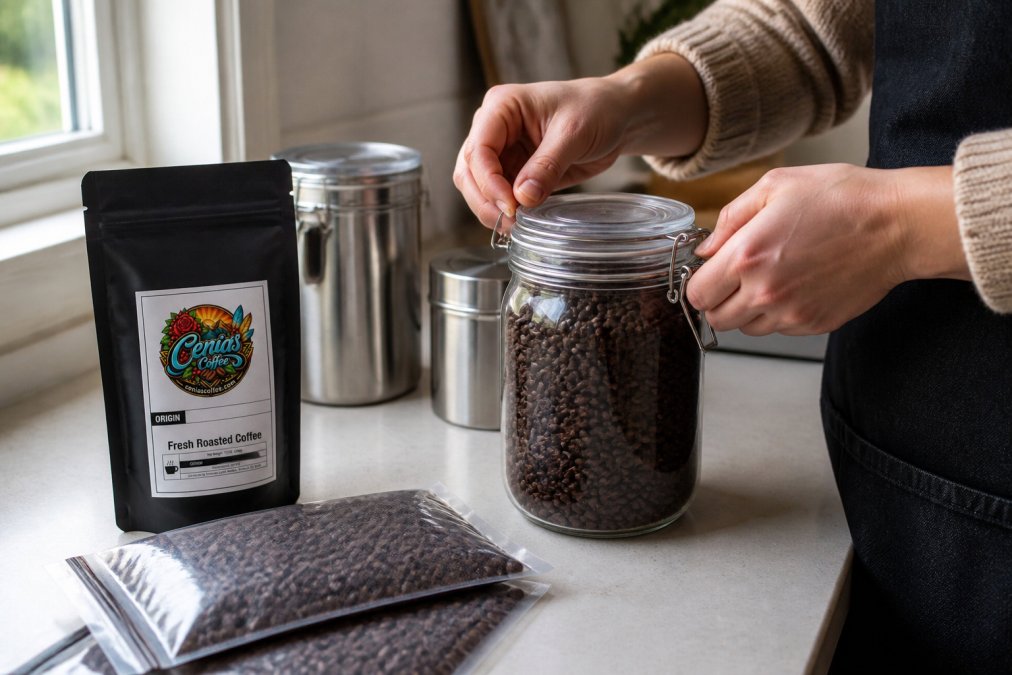
Airtight containers are essential. Oxygen triggers oxidation, breaking down flavor compounds. Vacuum-sealed bags work initially, but transfer opened bags to airtight glass jars with rubber gaskets or stainless steel canisters. Use opaque or tinted containers to block light exposure.
Store beans at room temperature (65-70°F) in a cool pantry away from appliances and direct sunlight. Avoid freezing or refrigerating, moisture from condensation accelerates degradation. Keep containers in a dry environment; add a desiccant packet if you live in a humid climate.
Label containers with roast dates and use a FIFO (first in, first out) rotation system. For bulk purchases, store only two weeks' worth in your primary container and keep the rest sealed in its original packaging in a cool, dark place.
Best Coffee Beans for Home Brewing
The best beans depend on your brewing method and preferences, but freshness and roast date transparency matter universally.
Single-origin beans from one specific region showcase terroir, the environmental factors shaping flavor. Cenia's Coffee offers single-origins like Brazil Santos, Colombia, and Costa Rica, each with distinct profiles from smooth cocoa notes to fruity complexity.
Blended coffees combine multiple origins for balanced, consistent cups. House blends work well across brewing methods; the 6Bean Blend, for example, is roasted dark for espresso but works equally well in drip coffee or French press.
Light roasts preserve origin characteristics for pour-over brewing. Medium roasts offer balance and versatility. Dark roasts bring deeper flavors ideal for espresso or French press. Freshness matters more than origin, a fresh medium roast outperforms a six-month-old single-origin. Buy from roasters who clearly label roast dates and ship within days of roasting.
Bulk Buying Pros and Cons
Pros:
Lower per-ounce cost saves 15-25% compared to individual bags. Ordering monthly instead of weekly saves time and reduces packaging waste. Consistency in flavor develops when bulk-buying from the same roaster.
Cons:
Freshness degradation is the hidden cost, some beans are consumed well past peak flavor. Storage space becomes a constraint for small households. Consumption changes create waste risk. Flavor variety suffers when committing to bulk quantities of one coffee.
| Factor | Bulk Buying | Smaller, Frequent Orders |
|---|---|---|
| Cost per ounce | Lower (15-25% savings) | Higher baseline cost |
| Freshness window | Risk of degradation after 2-3 weeks | Peak flavor throughout use |
| Storage requirements | Significant space needed | Minimal space |
| Flavor variety | Limited to bulk purchase | Easy to rotate origins |
| Shipping frequency | Once monthly | 2-4 times monthly |
| Waste risk | Higher if consumption changes | Lower |
When Bulk Buying Makes Financial Sense
Bulk buying delivers actual savings only when specific conditions align.
You consume more than one pound per week, the primary threshold. At this rate, a 5-pound bulk purchase stays within its flavor window for four to five weeks.
You've identified a roaster whose beans you genuinely enjoy and want regularly. Commitment to a specific roaster makes bulk purchases economical.
You have proper storage capacity and climate control, a cool, dry pantry with airtight containers.
You grind and brew fresh daily. Whole beans stay fresher than ground coffee; daily grinding maximizes the freshness window.
Your budget allows upfront cost. Bulk purchases require larger initial outlay.
You track consumption honestly. Before committing, track actual consumption for two weeks and multiply by 26 to estimate annual usage. The break-even point typically occurs around 50 pounds per year.
Subscription vs. Bulk: Which Fits Your Routine
Subscriptions deliver fresh coffee on a regular schedule, typically monthly, ensuring peak freshness. You never run out, though subscriptions cost 5-15% more per ounce than bulk purchases. Many subscriptions allow pausing or skipping months without penalty.
Bulk buying is a one-time purchase you manage yourself, minimizing shipping costs and packaging waste while giving you control over ordering.
For remote professionals and home office workers, subscriptions often make more sense. You're home to receive deliveries, and the routine of fresh coffee arriving creates a ritualistic element. The slight premium cost is often worth consistent flavor quality.
Sample packs like Cenia's Coffee's Single Origin Favorites Sample Pack ($24.99) and Best Sellers Sample Pack ($24.99) offer a middle ground, letting you explore different origins before committing to bulk.


Whether buying coffee in bulk is worth it depends on your consumption rate, storage capacity, and whether you prioritize cost savings or flavor freshness. For many home coffee enthusiasts, smaller frequent purchases or subscriptions deliver better value because the coffee tastes noticeably better. Per-ounce savings evaporate when half your purchase loses peak flavor.
At Cenia's Coffee, we help you find the right approach with sample packs to test origins before larger commitments, plus flexible ordering options matching your consumption. Our roasted-to-order model ensures beans arrive fresh, whether you order in bulk or prefer regular smaller shipments. Start with a sample pack, identify your favorite profiles, and decide whether bulk buying or subscription ordering fits your routine.
Frequently Asked Questions
Q: Is coffee cheaper when buying in bulk?
A: Yes, bulk purchasing typically reduces cost per ounce through economies of scale and lower packaging overhead. However, savings vary by roaster and order size. The real question is whether you'll consume the coffee before it loses freshness. If beans degrade before you use them, the bulk discount evaporates. Calculate your daily consumption rate first, then compare pricing across order sizes to find your break-even point.
Q: How long do coffee beans stay fresh after roasting?
A: Coffee beans peak in flavor 5-14 days after roasting, then gradually lose aroma and complexity through oxidation. In airtight containers away from light and heat, they remain drinkable for 3-4 weeks, though quality declines noticeably after 2-3 weeks. Vacuum-sealed packaging extends this window slightly. Roast date matters more than purchase date, look for beans roasted within the past two weeks for optimal freshness.
Q: What's the best way to store bulk coffee beans?
A: Store beans in airtight containers in a cool, dark place away from direct sunlight, heat, and moisture. Vacuum-sealed bags or opaque containers with one-way valves work best. Keep storage temperature stable between 60-70°F. Divide large quantities into smaller portions and open only what you'll use within 2-3 weeks. Avoid the freezer unless storing for months, condensation damages beans when thawed. Proper storage preserves both flavor profile and freshness preservation.
Q: How much money can you actually save by buying coffee in bulk?
A: Savings depend on consumption habits and current pricing. Someone drinking 2 cups daily uses roughly 0.5 pounds weekly. Buying 5 pounds at once typically saves 15-25% per pound versus smaller quantities. Over a year, that's $50-100 in savings for regular home brewers. However, if bulk purchases sit unused and oxidize, you waste money on degraded beans. Calculate your consumption habits first, bulk buying only saves money if you actually drink it while fresh.
This article was written using GrandRanker