

Premium Coffee Subscription for Home Office
Table of Contents
- How We Tested Premium Coffee Subscriptions
- Best Premium Coffee Subscription for Home Office
- Single-Origin vs. Blend: Roast Profiles and Flavor Notes
- Is Coffee Subscription Easy to Cancel?
- Coffee Subscription Frequency Guide for Remote Workers
- How to Store Coffee Beans for Maximum Freshness
- Cost-Per-Cup Analysis: Office Budget Considerations
- Conclusion
Last Updated: August 27, 2026
How We Tested Premium Coffee Subscriptions
We evaluated premium coffee subscriptions for home office use by focusing on freshness upon arrival, flavor consistency, subscription flexibility, and cost-per-cup value. We ordered from multiple providers, tracked delivery times, tested storage recommendations, and monitored how beans held up over two to three weeks of regular brewing. We examined single-origin offerings versus blends, analyzed roast profiles for compatibility with common home brewing methods, and verified whether cancellation policies matched advertised terms. The goal was to identify which premium coffee subscriptions deliver fresh, high-quality beans without locking users into unwanted charges or bulk quantities that go stale.
Best Premium Coffee Subscription for Home Office
A premium coffee subscription for home office work must balance freshness, flexible order quantities, and reasonable per-cup costs. Cenia's Coffee hits all three marks. Their beans are roasted to order, arriving fresher than pre-roasted inventory sitting in warehouses for weeks. This roast-to-order model is a significant differentiator in specialty coffee and directly addresses the stale coffee problem.
For home office professionals, you can order sample packs starting at $24.99, providing real variety without committing to full-pound bags. The Single Origin Favorites Sample Pack includes six 2-ounce portions. This flexibility matters enormously for remote workers who brew fresh daily but don't consume massive volumes.

Roast profiles are deliberately matched to brewing methods. Medium roasts work well for pour-overs and Chemex brewers with balanced acidity and body. Dark roasts deliver cocoa and molasses notes that shine in espresso or Moka pot brewing. This specificity prevents the frustration of ordering premium coffee that doesn't perform well with your actual equipment.
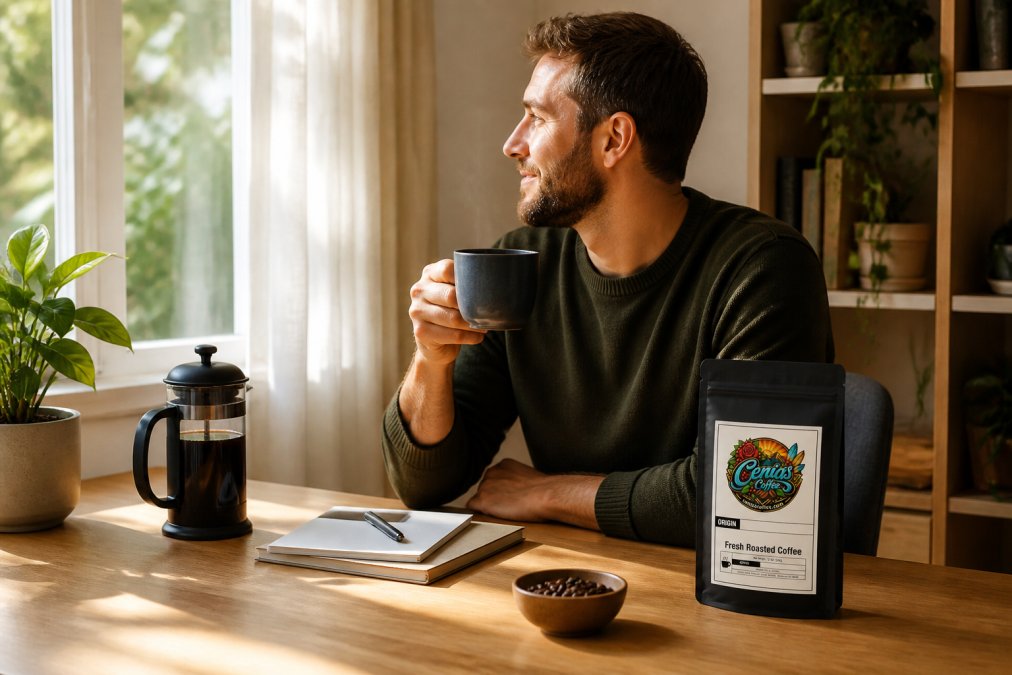
Delivery is reliable and transparent about processing time and delivery windows, which matters when planning your weekly coffee inventory. The one limitation: you'll pay more per pound than bulk commodity coffee. But you're paying for freshness, traceability, and flavor consistency, worth the investment for professionals who value a quality morning ritual.
Single-Origin vs. Blend: Roast Profiles and Flavor Notes
Single-origin coffees highlight unique regional characteristics: terroir, altitude, soil type, and processing method all come through in the cup. A single-origin Ethiopia from Cenia's Coffee displays milk chocolate, fruity, and caramel notes because of that region's volcanic soil and high altitude.
Blends combine beans from multiple origins to create a specific flavor profile. Cenia's Best Sellers Sample Pack: 6Bean, Cowboy, Breakfast, Peru, Mexico, Bali includes a dark roast house blend designed for espresso, creating a consistent, predictable cup across brewing methods. Their Breakfast Blend + adds Robusta beans for extra caffeine, useful for multiple cups throughout the workday.


For home office work, single-origin coffees reward attention and careful brewing, while blends are more forgiving and consistent across different grind sizes and water temperatures. Light roasts preserve acidity and origin characteristics but require precise brewing. Medium roasts are the sweet spot for most home brewers: approachable, work with standard techniques, and showcase origin flavor. Dark roasts deliver bold cocoa and caramel notes that don't require perfect technique.
The flavor notes on specialty coffee packaging are based on cupping, a standardized tasting process where trained evaluators assess the coffee like wine professionals. When Cenia's Coffee lists "dried orange, berry, chocolate" for their Colombia single-origin, those are actual tasting notes from their roastery's cupping process, providing a reliable guide for what to expect.
Is Coffee Subscription Easy to Cancel?
With Cenia's Coffee, cancellation is straightforward with no penalty for pausing or stopping. You control the frequency, you're not locked into monthly deliveries unless you choose that option. If you order a sample pack one week and don't want another delivery for three weeks, that's fine. There's no automatic renewal charging you for coffee you didn't request.
If you set up recurring deliveries and need to pause or cancel, the process is transparent. You can manage your subscription directly through your account without calling customer service. There's no retention email or guilt-inducing popup. You cancel, it's done.
Coffee Subscription Frequency Guide for Remote Workers
How often should you order? It depends on daily consumption, how quickly beans go stale, and your storage conditions.
Most remote workers drink one to three cups daily. A typical 12-ounce bag yields roughly 15-18 cups. A one-cup-per-morning person uses a bag in two to three weeks; two cups daily means one to two weeks. Sample packs cost more per ounce ($4.17 per ounce versus $1.92 for 12-ounce bags), but here's the trade-off: a 12-ounce bag degrades noticeably after three weeks, even in ideal storage. If coffee goes stale before you finish it, you're drinking mediocre coffee at premium price.
The practical frequency for most home office professionals: order every two to three weeks. This keeps beans fresh enough to taste the intended roast profile. For one to two cups daily, Cenia's sample packs hit this window perfectly. For heavy drinkers (three or more cups daily), a 12-ounce bag every 10 days makes sense. For light drinkers, sample packs every three to four weeks work well.
How to Store Coffee Beans for Maximum Freshness
Whole bean coffee is best within 7-10 days of roasting, acceptable for about 21 days, and noticeably degraded by day 30 (peer-reviewed research). Storage conditions determine where in that window your beans actually land.
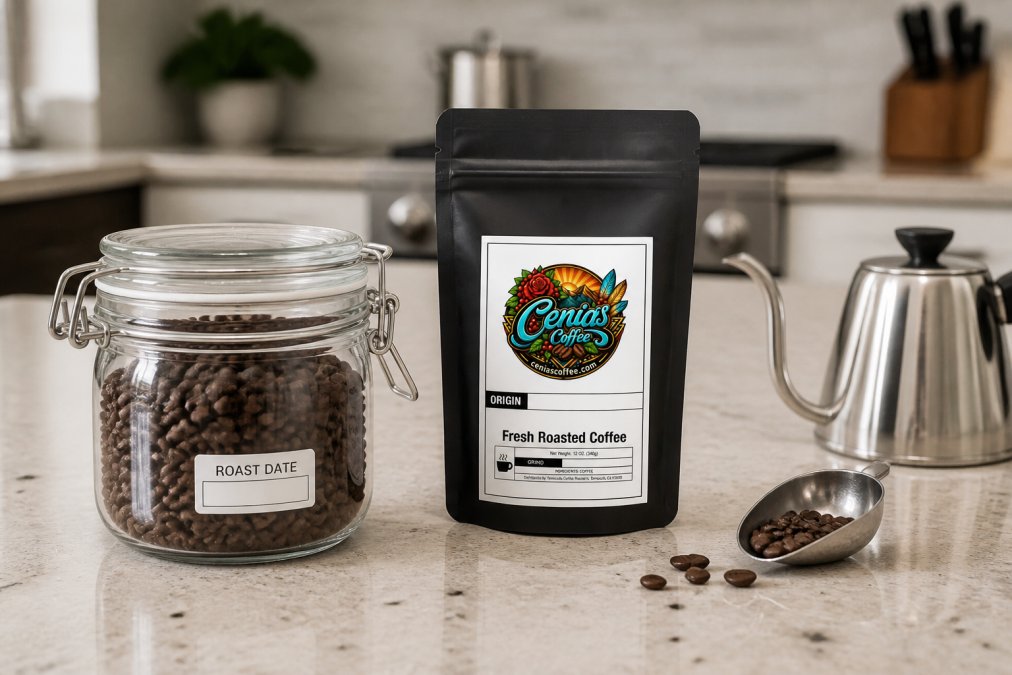
The best storage container is airtight and opaque. Glass works well in a dark cabinet; ceramic with an airtight seal is excellent. Avoid clear containers on open shelves. Room temperature storage between 60-75°F is fine, avoid areas near the stove or sunny windows (usda.gov).
Freezing whole beans works for months-long storage but introduces moisture risk when thawing. For the two to three week window remote workers typically operate in, room temperature in an airtight container is simpler and performs just as well.
Grind immediately before brewing. Pre-ground coffee oxidizes rapidly and is noticeably stale within hours. A burr grinder takes 90 seconds and makes an enormous difference in cup quality. Store beans away from strong-smelling foods, as coffee absorbs odors through surface oils.
The roast date matters more than the sell-by date. Cenia's Coffee prints the roast date on every bag. Use that as your reference point for your freshness window.
Cost-Per-Cup Analysis: Office Budget Considerations
For remote workers managing their own coffee budget, cost-per-cup is the real metric. A 12-ounce bag from Cenia's Coffee is $22.99 and yields roughly 15-18 cups, that's $1.28 to $1.53 per cup (sca.coffee). Compare that to specialty coffee shops charging $5-7 per cup. Home brewing is dramatically cheaper.
Sample packs are $24.99 for six 2-ounce portions, roughly $1.04 per 2-ounce cup equivalent. Yes, it's higher per-ounce than bulk bags, but if you're a light to moderate drinker, you avoid stale bean waste, which offsets the higher per-ounce cost.
Calculate your actual monthly consumption: count cups brewed at home and multiply by cost per cup, then compare to coffee shop spending. Most remote workers find premium home brewing pays for itself in 2-3 months. Equipment costs (grinder $40-80, brewer $30-150) amortize to $0.10-0.30 per cup over a year, still far cheaper than a coffee shop.
Conclusion
Working from home means your morning coffee ritual becomes a genuine anchor point in your day. A premium coffee subscription should deliver fresh, flavorful beans matching your brewing method, offer flexible ordering so you're not stuck with stale inventory, and make cancellation straightforward.
Cenia's Coffee delivers on all three fronts. Their roast-to-order model guarantees freshness most subscriptions can't match. Sample pack options eliminate the bulk-ordering trap. Subscription flexibility means you order on your schedule.
Get started with Cenia's Coffee and experience the difference fresh-roasted beans make. Try the Single Origin Favorites Sample Pack to find your preferred origins, or start with their Best Sellers Sample Pack: 6Bean, Cowboy, Breakfast, Peru, Mexico, Bali to understand their range.
Frequently Asked Questions
Q: Is a premium coffee subscription worth it for a home office?
A: Yes, if you drink multiple cups daily. Remote workers benefit from fresh, roasted-to-order beans that arrive on a schedule matching your consumption. A premium subscription eliminates stale coffee and shopping trips. Sample packs like the [Single Origin Favorites Sample Pack](https://ceniascoffee.com/products/single-origin-favorites-sample-pack) or [Best Sellers Sample Pack: 6Bean, Cowboy, Breakfast, Peru, Mexico, Bali](https://ceniascoffee.com/products/best-sellers-sample-pack-6bean-cowboy-breakfast-peru-mexico-bali) let you test quality before committing to larger quantities, reducing waste and cost per cup over time.
Q: How often should I order coffee for my home office?
A: Most home office workers go through one 12-ounce bag per week if they brew daily. Order every 2-3 weeks to maintain freshness while avoiding over-stocking. If you use a pour-over or French press, you'll consume beans faster than espresso users. Start with a sample pack to gauge your actual consumption rate, then adjust your coffee subscription frequency accordingly.
Q: What's the best way to keep coffee beans fresh after delivery?
A: Store whole beans in an airtight container away from light, heat, and moisture. A sealed glass or opaque container at room temperature preserves flavor for 2-3 weeks after the roast date. Grind only what you need immediately before brewing to maximize aroma and flavor. Check the roast date on your package and use within 30 days for peak quality.
Q: Can I easily pause or cancel my coffee subscription?
A: Yes. Most premium coffee subscriptions, including those focused on roasted-to-order delivery, allow you to pause, skip, or cancel orders without penalty. Review the cancellation policy before subscribing to confirm flexibility. If you're concerned about commitment, start with a one-time sample pack purchase to test the coffee before setting up recurring deliveries.
This article was written using GrandRanker