

Fresh Roasted Coffee Delivered to Home
Table of Contents
- What Makes Fresh Roasted Coffee Delivered to Home Different
- Understanding Roast Profiles for Your Brewing Method
- How to Store Coffee Beans for Maximum Freshness
- Single Origin vs. Blends: Finding Your Flavor Profile
- What Is Ethical Coffee Sourcing and Why It Matters
- Specialty Grade Beans and Roaster-Direct Advantages
- Cost-Per-Cup Analysis: Small-Batch Freshness vs. Bulk Buying
- Conclusion
Last Updated: August 22, 2026
What Makes Fresh Roasted Coffee Delivered to Home Different
When you order fresh roasted coffee delivered to your home, you're getting beans roasted within days of arrival, not weeks or months. Coffee begins degrading the moment roasting finishes as oxygen oxidizes the oils and flavor compounds break down (peer-reviewed research). A bag roasted three weeks ago tastes fundamentally flatter and less aromatic than one roasted three days ago.
Small-batch roasters operate differently from commodity suppliers. They roast frequently in smaller quantities, ensuring tighter inventory turnover and fresher product reaching your door.
Understanding Roast Profiles for Your Brewing Method
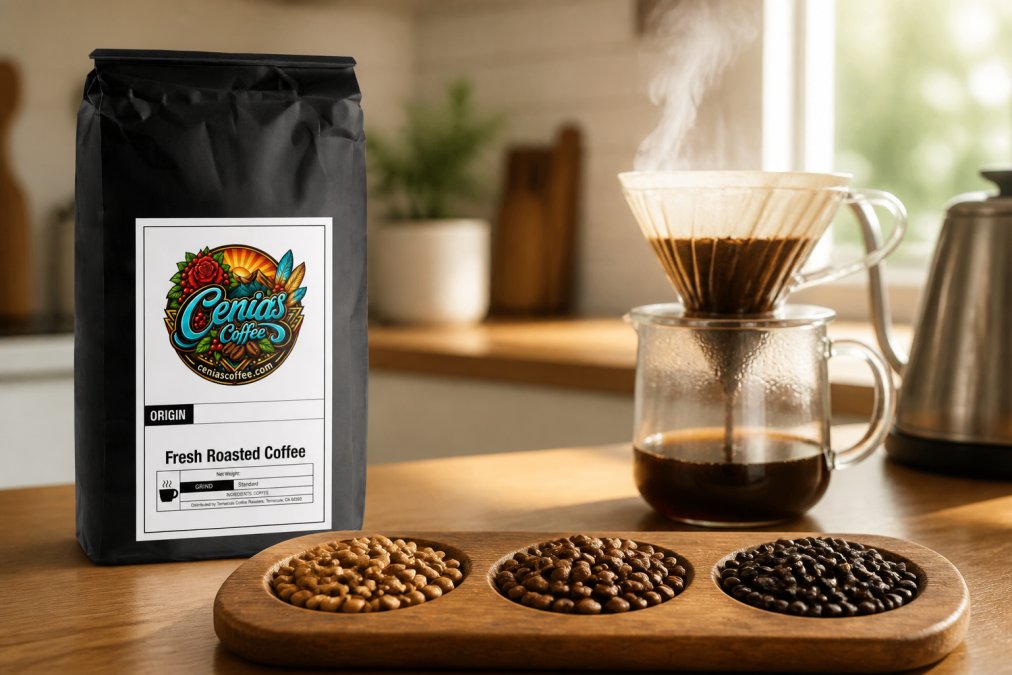
Roast profiles are chemical transformations that fundamentally alter how beans behave in your specific brewing setup. Light roasts, medium roasts, and dark roasts extract differently and require different water temperatures and grind sizes.
Light Roasts for Bright, Complex Flavors
Light roasts preserve the most origin characteristics, locking in the varietal's natural acidity and floral or fruity notes. They work best with pour-over, AeroPress, and Chemex brewers where you control water temperature precisely. Espresso machines tend to amplify the acidity into something harsh.
Light roasts are unforgiving, under-extract and the coffee tastes sour, over-extract and it becomes astringent. For precision brewers, though, they're where specialty grade beans truly show their value.
Medium Roasts for Balance and Versatility
Medium roasts represent the sweet spot for most home brewers. The roaster takes beans through the first crack and partway into the second, developing deeper body while preserving enough origin character to distinguish single origins. You get sweetness, balanced acidity, and chocolate and caramel notes.
Medium roasts work across nearly every brewing method, pour-overs, Chemex, AeroPress, French press, automatic drip. If you're new to fresh roasted coffee delivered and unsure what profile to start with, medium roasts are the logical entry point.
Dark Roasts for Bold, Rich Bodies
Dark roasts are roasted well into the second crack, developing deep body and reducing acidity. They excel in espresso machines, French presses, and Turkish coffee preparation where the heavy body stands up to milk and foam.

A skillfully roasted dark roast shows intentionality. Quality dark roasts taste complex in a different register than light roasts, not burnt or one-dimensional.
:::pro-tip If you switch brewing methods, reconsider your roast profile. A light roast perfect for your Chemex won't perform well in a French press. Ask your roaster for a recommendation based on your actual brewing setup. :::
How to Store Coffee Beans for Maximum Freshness
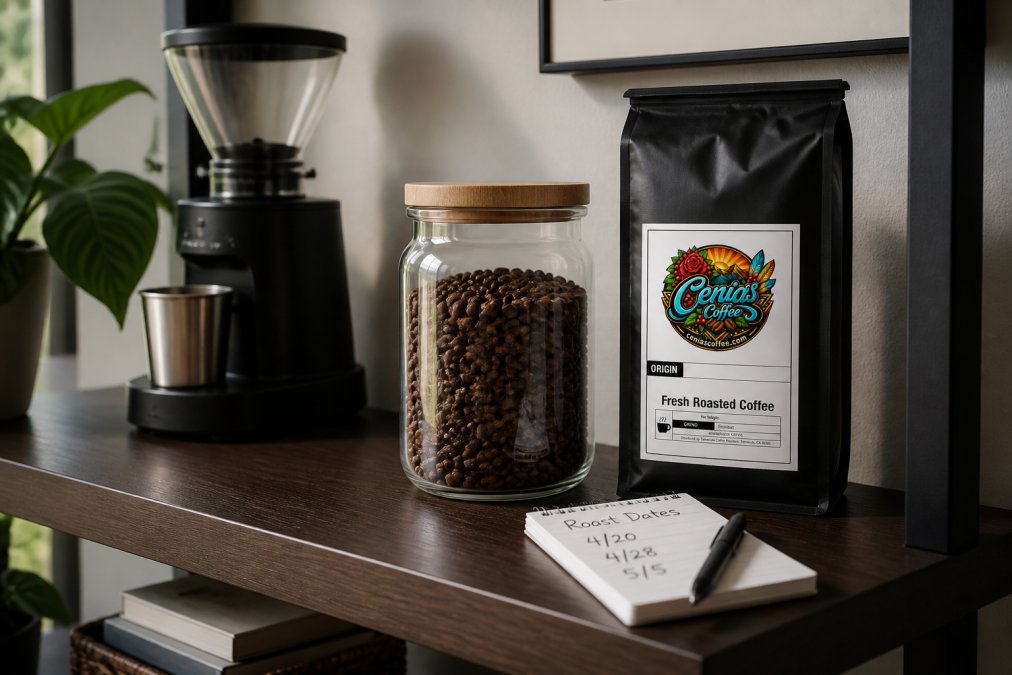
Storage is where most home brewers underperform. The enemies are oxygen, light, heat, and humidity. Control these four factors and your beans stay fresh far longer than most people expect.
The Degassing Window and Optimal Timing
After roasting, coffee beans release CO2 for 24 to 48 hours (peer-reviewed research). When your fresh roasted coffee delivered arrives, it's typically 3 to 5 days post-roast, meaning most degassing is complete. Many enthusiasts prefer to wait another day or two, allowing beans to fully stabilize.
Optimal brewing happens between day 3 and day 14 post-roast. This is when degassing is complete and oxidation hasn't yet degraded volatile compounds. After day 14, aroma and brightness begin noticeably fading.
Container Choices and Environmental Factors
Oxygen is the primary enemy. Airtight containers are non-negotiable. Glass or ceramic airtight containers with one-way valves work well, the valve lets residual CO2 escape without letting oxygen in. Keep the container in a cool, dark place like a pantry, away from the stove. Room temperature (around 68°F) is ideal.
Grind immediately before brewing. Ground coffee has exponentially more surface area exposed to oxygen. If you must grind ahead, consume within 24 hours.
Single Origin vs. Blends: Finding Your Flavor Profile
Single origin beans come from one specific region, farm, or cooperative. Blends combine beans from multiple origins. Neither is inherently superior; they serve different purposes.

Single origin coffees let you taste the specifics of place. A Kenya from Othaya tastes distinctly different from an Ethiopia from Sidama. Single origins are ideal for pour-over and precision brewing methods. Cenia's Coffee's Single Origin Favorites Sample Pack gives you six different regions in 2oz packs, Brazil Santos, Colombia, Costa Rica, Ethiopia, Honduras, and Tanzania, so you can identify which origins resonate with your palate.
Blends combine complementary origins to achieve a specific flavor target. They're forgiving and perform well across different brewing methods because they're designed for consistency. Many people prefer blends for everyday drinking because they're reliable and don't demand the precision that single origins sometimes do.
What Is Ethical Coffee Sourcing and Why It Matters
Ethical sourcing means the coffee you're buying supports farmers fairly, protects the environment, and maintains transparency about where beans come from. Direct trade is one model where roasters buy directly from farmers, cutting out middlemen and ensuring more of the purchase price reaches the grower.
Certifications like Fair Trade or Rainforest Alliance provide third-party verification. When a roaster claims "trusted farms," ask what that means specifically. Cenia's Coffee sources from named cooperatives and specific regions, Honduras coffee comes from Cafe Organics Marcala with 1,500 grower members; Ethiopia Natural comes from smallholder farmers in the Sidama zone. This specificity shows the roaster knows their supply chain.
Specialty Grade Beans and Roaster-Direct Advantages
Specialty grade is a classification assigned by the Specialty Coffee Association based on cupping scores. Beans scoring 80 points or higher are considered specialty grade, meaning they've been evaluated for defects, flavor clarity, balance, and overall quality (sca.coffee). Commodity coffee scores below 80 and contains visible defects.
Specialty grade beans cost more because they're genuinely different, grown at higher altitudes, processed more carefully, and handled with more attention to detail.
Roaster-direct means buying from the roaster who roasted the beans, not through a middleman. You get fresher beans, transparency about roast dates, and often better pricing. Small-batch roasters don't need massive inventory because they roast frequently and ship directly to customers, ensuring your fresh roasted coffee delivered is actually fresh.
Cost-Per-Cup Analysis: Small-Batch Freshness vs. Bulk Buying
A typical 12oz bag of specialty grade fresh roasted coffee delivers roughly 40 cups of brewed coffee. At Cenia's Coffee, single origin beans run $22.99 per 12oz bag, about $0.57 per cup. Bulk commodity coffee might be $0.35 per cup, but it loses 30-40% of its flavor quality within two weeks.
If you drink half a bag before it goes stale, you're paying double the per-cup cost because you're throwing away half the product's value. Fresh roasted coffee delivered in smaller quantities eliminates waste, you finish a 12oz bag in two weeks, stay within the optimal flavor window, and never discard stale beans.
When you factor in quality and waste, the prices are nearly identical. The difference is you're getting what you're actually paying for with fresh roasted coffee delivered.
Sample packs offer another angle. Cenia's Coffee's Best Sellers Sample Pack at $24.99 gives you six different 2oz packs, 6Bean Blend, Cowboy Blend, Breakfast Blend, Peru, Mexico, and Bali. That's six different brewing experiments for about $4.17 per origin, letting you discover what you actually like before committing to full bags.

| Purchasing Model | Cost Per Cup | Waste Factor | Effective Cost | Flavor Quality |
|---|---|---|---|---|
| Bulk commodity | $0.35 | 40% waste | $0.58 | Degraded after 2 weeks |
| Fresh roasted specialty | $0.57 | 5% waste | $0.60 | Peak for 2-3 weeks |
| Sample packs | $0.42 avg | Discovery phase | Varies | High, with variety |
Fresh roasted coffee delivered to your home transforms how you experience coffee daily. Start by understanding your brewing method and matching it to the right roast profile. Focus on storage, airtight container, cool dark place, grind immediately before brewing. If you're uncertain which origins suit your palate, sample packs let you experiment without waste. Cenia's Coffee's commitment to roasting to order and sourcing from named cooperatives means you're getting transparency and confidence your beans arrive fresh. The investment in quality beans and proper technique pays dividends in every cup.
Frequently Asked Questions
How long does fresh roasted coffee stay fresh?
Fresh roasted coffee peaks in flavor 5-7 days after the roast date as CO2 degasses from the beans, then remains optimal for 2-3 weeks when stored properly. After 4 weeks, the beans begin losing their vibrant tasting notes and aroma. Whole beans last longer than ground coffee because grinding exposes more surface area to oxygen. Store in an airtight container away from light and heat to extend freshness.
What is the best fresh roasted coffee for pour over brewing?
Pour-over brewing works best with medium roasts and light-to-medium roasts that highlight the bean's origin characteristics. Single-origin coffees like Kenya or Ethiopia Natural showcase bright acidity and floral notes that pour-over methods extract beautifully. Grind coarse to medium-coarse, use water just off boiling, and pour slowly for 3-4 minutes. Sample packs like the Single Origin Favorites let you test different roast profiles to match your pour-over technique.
Does delivery affect the quality of fresh roasted coffee?
Delivery itself does not harm coffee quality if roasted-to-order beans are shipped within 1-3 days of roasting. The key is timing: beans shipped too soon (before degassing begins) may taste flat, while those shipped after 2 weeks lose peak freshness. Reputable roasters ship during the optimal 5-10 day window. Check the roast date on your package immediately upon arrival to verify freshness and plan your brewing schedule accordingly.
Why does ethical coffee sourcing matter for home delivery?
Ethical sourcing ensures the farmers who grew your beans receive fair compensation and work under safe conditions, which directly impacts bean quality and sustainability. Transparently sourced coffees, like those from direct-trade cooperatives, are typically specialty grade, meaning they score 80+ on the cupping scale and deliver superior flavor. When you buy ethically sourced fresh roasted coffee, you're investing in higher-quality beans while supporting farming communities that practice sustainable cultivation.
This article was written using GrandRanker