

How to Clean Your Pour Over Coffee Maker
Table of Contents
- Why Cleaning Your Pour Over Coffee Maker Matters
- What You'll Need to Clean Your Pour Over
- Daily Cleaning Routine for Your Pour Over Coffee Maker
- How to Descale a Coffee Maker Weekly
- Cleaning Metal Coffee Filters Properly
- How Often to Clean Coffee Equipment
- Materials and Methods to Avoid
- Troubleshooting Persistent Odors and Stains
- Frequently Asked Questions
Last Updated: October 6, 2026
Why Cleaning Your Pour Over Coffee Maker Matters
A clean pour over coffee maker is the foundation of great-tasting coffee.
Most people skip regular cleaning, assuming a quick rinse is enough. It isn't. Coffee oils oxidize and cling to every surface, the dripper, the filter, the carafe, and turn rancid.
The good news: learning how to clean your pour over coffee maker takes minutes, not hours. A daily rinse and weekly deep clean keep it performing at its best.
What You'll Need to Clean Your Pour Over
You probably already own everything required:
- Fresh water (tap water works fine for daily cleaning)
- A soft brush or cloth (avoid harsh scrubbers that scratch ceramic or glass)
- White vinegar (for weekly descaling)
Keep removable parts, like a metal filter basket or rubber seal, separate so you can reach every crevice. If your brewer came with a cleaning brush, use it, it makes the job faster and more thorough.
Daily Cleaning Routine for Your Pour Over Coffee Maker
Rinsing immediately after brewing
The moment you finish brewing, rinse your dripper. Fresh grounds and oils rinse away far easier while warm and wet.
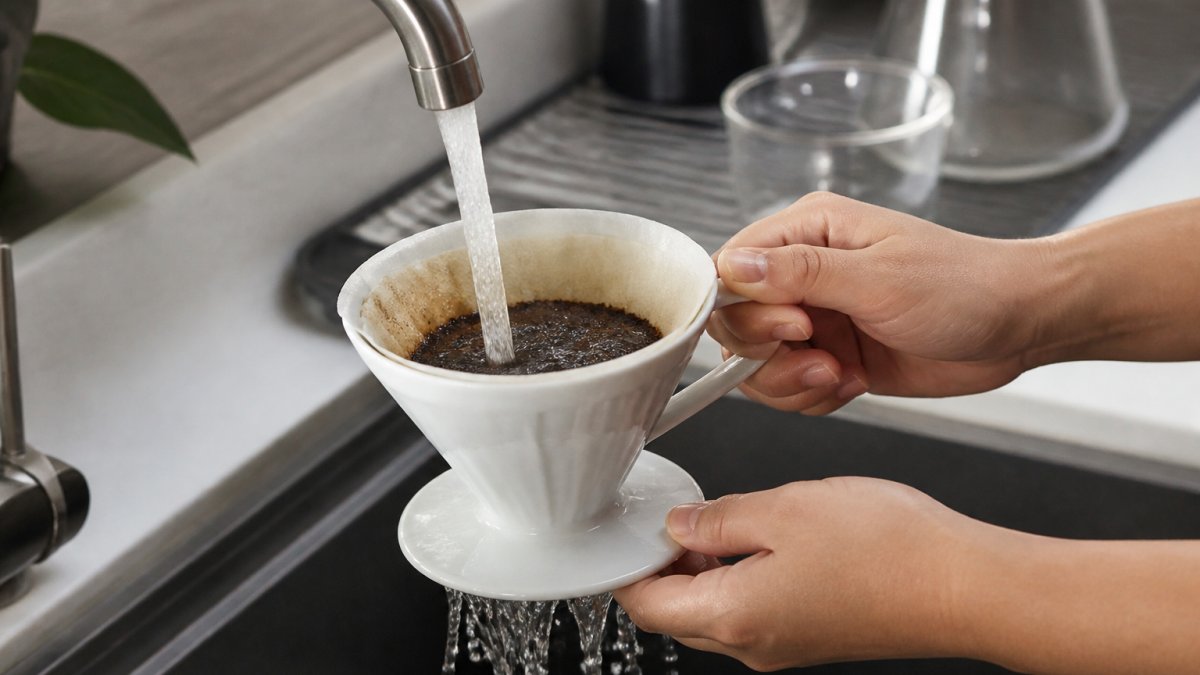
Hold it under running water, letting it flow through the filter basket and down the sides.
Empty and rinse your carafe immediately with warm water. Coffee left sitting for hours oxidizes and leaves stubborn stains that are harder to remove later.
Air-drying your equipment
After rinsing, place all parts upside down on a clean towel or drying rack. Wet equipment left in a closed cabinet develops mold and musty odors.
Let everything dry completely before storing, usually 30 minutes to an hour. If you brew multiple times daily, keep equipment on the counter between uses instead of putting it away wet.
For metal filters, shake off excess water and lay them flat; they dry fast and need no care beyond rinsing.
How to Descale a Coffee Maker Weekly
Descaling is not the same as routine cleaning. Routine cleaning removes coffee oils, grounds, and surface residue with warm water and a soft brush. Descaling removes mineral scale, the chalky white or gray crust hard-water minerals leave behind. If you only rinse, oils come off but scale stays; if you only descale, scale dissolves but rancid oils remain. A pour over brewer needs both, on different schedules.
Which parts actually need descaling
Scale forms where water sits, boils, or evaporates: the kettle interior and spout, the dripper's drainage holes, the carafe, and any reusable metal filter.
Quick test: run your fingernail along the inside of the kettle or carafe. A rough, chalky film is scale; a slick or oily surface is coffee residue that warm water and a drop of dish soap will handle.
The vinegar-water solution, by material
A 1:1 mix of plain white vinegar and fresh water is the standard starting point, but safe soak time depends on the material.
- Borosilicate glass carafes and glass drippers: 1:1 solution, soak 15 to 20 minutes. Glass tolerates vinegar well and is the easiest material to descale.
- Ceramic drippers: 1:1 solution, soak 10 to 15 minutes. Check for a glazed interior. Unglazed or hand-painted ceramic can absorb vinegar and fade, so keep soaks short and rinse immediately.
- Stainless steel kettles, metal filters, and gooseneck spouts: 1:1 solution, soak 15 to 20 minutes. Stainless steel is durable, but avoid leaving vinegar in contact for hours, which can dull the finish.
For a gentler option on ceramic or plastic, use a 1:2 vinegar-to-water ratio and extend the soak by 5 minutes.
Step-by-step descaling routine
- Disassemble the brewer, removing the dripper, filter basket, gasket, and any removable parts.
- Mix 1 part white vinegar with 1 part fresh water, enough to fully submerge the parts you are soaking.
- Submerge the dripper, filter basket, and metal filter, and set a timer based on the material times above.
- For the kettle, fill it one-third with the solution, bring it to a gentle simmer, turn off the heat, and let it sit 10 minutes. Do not boil vinegar hard; the fumes are unpleasant and unnecessary.
- For the carafe, pour in enough solution to cover the stained area and let it stand 15 minutes.
- Scrub gently with a soft bottle brush, paying attention to the dripper's drainage holes and the base of the kettle spout, where scale collects first.
- Rinse every part under warm running water for at least 30 seconds.
- Run two full rinse cycles with fresh water, then smell the final rinse water. If you detect vinegar, run another cycle.
When vinegar is not enough
Heavy scale may not come off with a single vinegar soak. Repeat the soak rather than reaching for a stronger acid, two or three 15-minute soaks with a gentle scrub between them are safer than one long soak, especially on ceramic and plastic. If scale still won't budge on a metal kettle, use a dedicated descaling product for coffee equipment and follow its label directions.
Cleaning Metal Coffee Filters Properly
Metal filters are reusable, durable, and more environmentally friendly than paper, but they trap fine coffee particles.
Weekly, soak it in the vinegar-water solution for 10 minutes to remove oils that accumulate in the mesh and can impart a metallic taste, then rinse thoroughly.
A dull or discolored appearance is normal oxidation and doesn't affect performance.
Store metal filters dry. Never leave them wet in a drawer. Moisture trapped in the mesh promotes rust and off-flavors.
How Often to Clean Coffee Equipment
Most guides give one schedule for every brewer, but knowing how to clean your pour over coffee maker means understanding that the parts are separate and the materials vary. A glass carafe, ceramic dripper, stainless steel kettle, and reusable metal filter each tolerate heat, acid, and soaking differently. The schedule below separates routine cleaning from descaling so you do neither more nor less work than necessary.
Routine cleaning schedule
Routine cleaning means warm water, a soft brush, and occasionally a drop of mild dish soap. It removes coffee oils, grounds, and surface film.
- After every brew: Rinse the dripper, filter basket, and carafe immediately. Warm water and 15 to 20 seconds of rinsing is enough. Do not let grounds sit.
- Every one to three days: Wash the carafe and any reusable metal filter with warm water and a drop of mild dish soap, then rinse thoroughly. This handles the oil film that plain water leaves behind.
- Weekly: Disassemble removable parts, including gaskets and seals, and wash them individually. Use a soft bottle brush on the dripper's drainage holes and the inside of the kettle spout.
Descaling schedule
Descaling means dissolving mineral scale with a vinegar-water solution. It's separate from routine cleaning and doesn't need to happen as often.
- Soft water: Descale every three to four weeks.
- Moderately hard water: Descale every two weeks.
- Hard water: Descale weekly, and consider filtering your brewing water to slow the buildup.
Check your water hardness through your municipal water report or an inexpensive test strip. Filtered or bottled water builds scale more slowly, so you can stretch the interval.
Material-specific care notes
- Glass carafes: Dishwasher-safe on the top rack for most models, but hand washing preserves clarity and avoids clouding over time.
- Ceramic drippers: Hand wash only. Avoid thermal shock by letting the dripper cool before rinsing with cold water.
- Stainless steel kettles and filters: Hand wash. Do not leave standing water in the kettle between uses, which encourages scale and can affect the interior finish.
- Plastic drippers: Hand wash in warm, not hot, water. Check the manufacturer's care instructions before putting any plastic part in a dishwasher.
A concise pour over routine
For one repeatable habit, use this sequence:
- Brew.
- Rinse the dripper, filter, and carafe with warm water within a few minutes.
- Air-dry everything upside down on a rack.
- Weekly, wash removable parts with mild soap and a soft brush.
- Every one to four weeks, depending on water hardness, descale with a 1:1 vinegar-water solution.
- Rinse twice with fresh water after every descale.
Signs it is time to clean early
Do not wait for the calendar if you notice any of these:
- Slow water flow through the dripper
- A chalky or rough film inside the kettle
- A bitter, stale, or metallic taste in an otherwise familiar bean
- Visible brown or white buildup on the carafe or filter basket
Any one of these is a signal to clean now, not next week.
| Cleaning Task | Frequency | Time Required |
|---|---|---|
| Rinse dripper, filter, and carafe | After every brew | 2-3 minutes |
| Wash with mild dish soap | Every 1-3 days | 3-5 minutes |
| Wash removable parts and gaskets | Weekly | 5-10 minutes |
| Descale with vinegar solution | Every 1-4 weeks, based on water hardness | 15-20 minutes |
| Replace worn gaskets or seals | As needed | 5 minutes |
| Address visible buildup or slow flow | Immediately | 15-20 minutes |
Materials and Methods to Avoid
Not all cleaning methods work for pour over equipment.
Skip bleach and harsh chemicals. Bleach damages equipment and leaves toxic residue that contaminates your coffee.
Don't use dishwasher detergent for soaking. Detergent leaves a film that affects taste.
Don't forget to rinse thoroughly after vinegar. Leftover vinegar ruins your next brew.
Never use scented vinegars. Stick to plain white vinegar. Flavored varieties leave residual taste.
Troubleshooting Persistent Odors and Stains
Bitter or stale taste: This signals oxidized oils.
Musty or moldy smell: Your equipment is staying wet too long.
Brown or white crusty buildup: Mineral deposits from hard water.
Slow water flow: Mineral clogging the drainage holes. Descale immediately.
Discolored carafe or dripper: Coffee stains are mostly cosmetic and don't affect flavor.
Metallic taste: Your metal filter needs deeper cleaning.
Frequently Asked Questions
Can you run vinegar through your coffee maker to clean it?
Yes, vinegar is one of the most effective cleaning solutions for pour-over equipment. Mix equal parts white vinegar and water, pour it through your dripper slowly, and let it sit for 15-20 minutes. This removes coffee oils, mineral deposits, and limescale buildup. Follow with multiple rinse cycles using fresh water to eliminate any vinegar taste before brewing your next cup.
How can I clean a metal pour-over filter?
Rinse your metal filter immediately after brewing under hot running water to remove coffee grounds. For weekly deep cleaning, soak it in a vinegar-water solution (one part vinegar to one part water) for 20 minutes, then scrub gently with a soft brush to remove residual oils. Rinse thoroughly with fresh water and air-dry completely before storing.
How often should you deep clean a pour over coffee maker?
Clean removable parts daily after brewing, but deep cleaning with a vinegar-water solution should happen weekly if you brew daily, or every two weeks if you brew less frequently. If your water is hard or mineral-rich, descale more often. Pay attention to brewing time, if it slows noticeably, mineral buildup requires immediate descaling.
Does coffee oil buildup affect the taste of pour over coffee?
Yes, accumulated coffee oils and residue create stale, bitter flavors and can mask the fresh, smooth character of specialty beans. Regular rinsing after each brew and weekly descaling removes these oils, ensuring your pour-over equipment delivers the clean, bright flavor profile you're paying for with premium, freshly roasted beans.
Clean equipment transforms your coffee experience. When your dripper and carafe are free of oils and mineral buildup, the bright, complex flavors in premium beans shine through. At Cenia's Coffee, we believe that roasting exceptional beans is only half the equation, the other half is brewing them in clean equipment. Follow this simple routine: rinse daily, descale weekly, and address buildup as it appears. Your morning cup will thank you.