

Which Coffee Mug Keeps Your Brew at the Right Temperature?
Last Updated: November 1, 2026
Quick Summary
The best coffee mugs for holding brewing temperature are double-wall vacuum-insulated stainless steel travel mugs, which keep coffee warm far longer than ceramic or enamel. Ceramic mugs suit desk drinking where flavor matters most, and enamel mugs suit outdoor use. Warming any mug with hot water before pouring also helps.
- Double-wall vacuum-insulated stainless steel is the only material that reliably keeps coffee hot for an hour or more.
- Ceramic is flavor-neutral and microwave safe, but it loses heat within about 20 to 30 minutes.
- Preheat any mug with hot tap water for about a minute before pouring.
- The 25 oz travel mug is 7.9 inches tall and fits most car cup holders.
Table of Contents
- Why Brewing Temperature Matters More Than Most Mugs Admit
- How Mug Materials Affect Heat Retention: Ceramic, Stainless Steel, and Enamel
- Best Insulated Coffee Mugs for Long Heat Retention
- Temperature-Controlled Coffee Mug Features: Do They Justify the Cost?
- How to Keep Coffee Hot Longer Without Buying a New Mug
- Choosing Your Mug and Brewing at the Right Temperature
- Frequently Asked Questions
Why Brewing Temperature Matters More Than Most Mugs Admit
Coffee tastes different at different temperatures, and most people only notice when their cup has gone lukewarm. This guide from Cenia's Coffee looks at which mugs hold heat well, how materials and lids change the result, and when a premium feature is worth paying for. We focus on the mugs themselves, not on brewing equipment, and we keep every claim tied to what the products are built to do.
A mug that holds heat well gives you more time to drink at a temperature you enjoy. Heat escapes through the walls, the rim and the lid, so the design of each part matters. A thick ceramic mug feels solid but can lose warmth quickly once the first sips are gone. A double-wall stainless steel bottle slows that loss considerably. Neither is wrong for every drinker, but the trade-offs are different.
The goal is to help you match a mug to how you drink coffee: at a desk, on a commute, or on a trail.
How Mug Materials Affect Heat Retention: Ceramic, Stainless Steel, and Enamel
Material is the first thing that shapes how long coffee stays warm, and it also shapes how the coffee tastes. The three materials most coffee mugs use, ceramic, stainless steel, and enamel, lose heat through different mechanisms, so the right choice depends on whether you care more about heat retention, flavor, or durability.
Ceramic is a poor insulator. A single-wall ceramic mug transfers heat from the coffee straight through the wall and out into the room, and it also loses heat through the open rim and the uninsulated handle. Thick stoneware slows that loss a little compared with thin porcelain, but the difference is modest. The trade-off is that ceramic is chemically inert and does not hold odors, so it is the most flavor-neutral option and the easiest to keep tasting clean over years of use. Most ceramic mugs are also microwave and dishwasher safe, which matters if you reheat at a desk.
Stainless steel conducts heat quickly, which sounds like a disadvantage, and it is, in a single-wall steel cup, which can become uncomfortable to hold and loses heat fast. That is why insulated steel mugs use two walls with a vacuum or air gap between them. The inner wall absorbs heat from the coffee, but the gap blocks conduction and convection to the outer wall, so the outer surface stays cool to the touch and the coffee retains heat far longer than in any single-wall vessel. The trade-off is that steel can carry a metallic note into very acidic coffee and can retain odors if it is not cleaned thoroughly, and most insulated steel mugs are hand-wash only.
Enamel is a glass coating fused onto steel. It sits between ceramic and single-wall steel: the glass surface is flavor-neutral like ceramic, but the steel core conducts heat, so a single-wall enamel mug will not hold heat like a vacuum-insulated bottle. Enamel is light and durable against drops, which is why it suits camping, but it chips if abused and can stain from coffee oils over time. Do not heat liquids or food directly in an enamel mug, because thermal shock can damage the coating.
A practical way to think about it: if you drink within 20 to 30 minutes and care most about flavor neutrality, ceramic is the right tool. If you need coffee to stay hot for an hour or more, double-wall vacuum-insulated stainless steel is the only material that reliably does it. Enamel is the outdoor and everyday compromise.
Our Travel Mug with a Handle is made with stainless steel, which makes it a practical choice for a long commute. Our Enamel Mug suits camping and everyday use.


Best Insulated Coffee Mugs for Long Heat Retention
Insulated mugs are the strongest option for keeping coffee hot over an hour or more, but "insulated" covers a wide range of performance. The two formats most people choose are a double-wall vacuum-insulated travel mug and a ceramic mug for home or desk use. They are not interchangeable, so compare them by where you will actually drink and how long you need the coffee to stay hot.
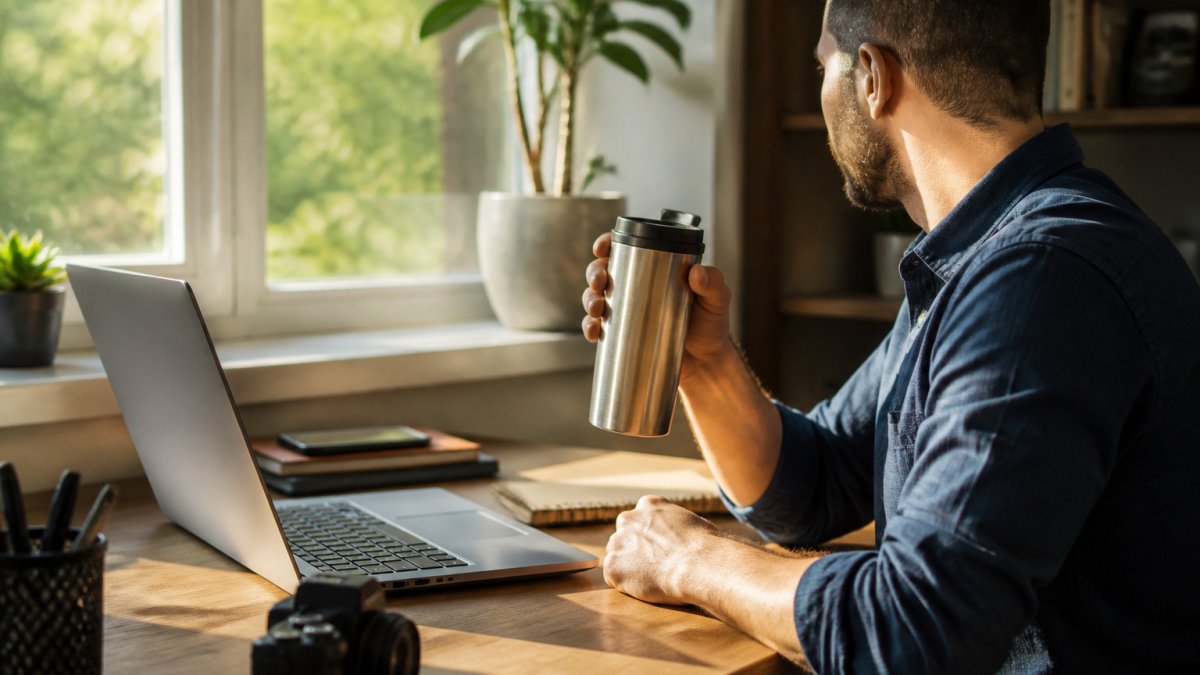
A useful frame is to separate keeping coffee hot from maintaining a preferred drinking temperature. Coffee brewed around 195-205°F is too hot to drink immediately; most people find it pleasant somewhere in the 130-150°F range. A vacuum-insulated mug does not hold coffee at brewing temperature, nothing passive does, but it slows the drop enough that you get a longer window in the pleasant range. A ceramic mug gives you a shorter window, and a single-wall enamel mug shorter still.
Travel Mug with a Handle: Sizes, Lid Design, and Heat Performance
Our travel mug comes in a 25 oz (739 ml) size and a 40 oz (1183 ml) size. The 25 oz version is 7.9 inches (20 cm) tall and fits most car cup holders. The 40 oz version is 10.4 inches (26.5 cm) tall. The 25 oz model comes with a plastic press-in lid, while the 40 oz model includes a plastic straw and a screw-on lid.
Hand-wash only.
Best for: commuters who want one mug that goes from car to office.
Skip if: you want a mug you can toss in the dishwasher.
Ceramic and Enamel Options for Home and Desk Use
For a desk, ceramic mugs are the most common choice. Our Mug with Color Inside is ceramic and dishwasher and microwave safe. Its 11 oz size measures 3.79 inches (9.6 cm) tall and 3.25 inches (8.3 cm) across, and the 15 oz size is 4.69 inches (11.9 cm) tall. Our White Glossy Mug is also ceramic and dishwasher and microwave safe, available in 11 oz, 15 oz and 20 oz sizes.
Our Enamel Mug is lightweight. Do not heat liquids or food directly in it, because that can damage the coating. Enamel can stain from coffee and tea over time.
The two sizes and key specs of the travel mug are summarised below.
| Item | Value | Note |
|---|---|---|
| 25 oz travel mug | 7.9 in (20 cm) tall | Fits most car cup holders |
| 40 oz travel mug | 10.4 in (26.5 cm) tall | Includes plastic straw and screw-on lid |
| Mug with Color Inside, 11 oz | 3.79 in (9.6 cm) tall | Ceramic, dishwasher and microwave safe |
| Mug with Color Inside, 15 oz | 4.69 in (11.9 cm) tall | Ceramic, dishwasher and microwave safe |
| Travel mug care | Hand-wash only | Not dishwasher safe |
Temperature-Controlled Coffee Mug Features: Do They Justify the Cost?
Temperature-controlled mugs add a display, a heating element or a set temperature mode. They can hold a drink at a chosen temperature for longer than a passive insulated mug. Whether that is worth the cost depends on how much you care about exact temperature and how often you drink slowly.
Our catalog does not include a temperature-controlled mug, so we cannot give you test data on one. For most people who want reliable heat retention without a display, a well-built insulated mug covers the need at a lower price. Temperature control makes the most sense if you regularly let coffee sit for an hour or more and want it at the same temperature throughout.
Watch out: heating-element mugs need charging or power, which adds one more thing to manage each morning.
How to Keep Coffee Hot Longer Without Buying a New Mug
You can extend the life of hot coffee with a few simple habits, even if you already own a mug. Warm the mug with hot water for a minute before pouring. Keep the lid closed when you are not drinking. Pour into a mug you will finish within 30 to 45 minutes, not a large one you will sip for hours.
These steps do not replace insulation, but they make a plain mug perform noticeably better. If you find yourself repeatedly drinking lukewarm coffee, an insulated travel mug is the more reliable fix.
Choosing Your Mug and Brewing at the Right Temperature
Choose the mug based on where you drink. For a commute, the Travel Mug with a Handle is made with stainless steel. For a desk, the Mug with Color Inside or the White Glossy Mug are dishwasher and microwave safe. For camping or hiking, the Enamel Mug is lightweight.
The mug matters, but so does the temperature you brew at. Our gooseneck kettle guide explains how to control water temperature, and our guide to water temperature for pour-over coffee shows how temperature changes flavor. Pair the right mug with the right brewing temperature and you will get a cup that stays good from first sip to last.
Frequently Asked Questions
Which coffee mug keeps coffee at the right temperature the longest?
Preheating the mug with hot water for a minute before pouring adds further retention, and keeping the lid closed whenever the mug is not being sipped from also helps.
Are ceramic or stainless steel mugs better for keeping coffee hot?
Stainless steel is better for heat retention, especially when it is double-wall vacuum insulated. Ceramic is a poor insulator on its own and cools noticeably within minutes, though it has advantages in taste neutrality, a classic feel, and easy dishwasher cleaning. Ceramic also does not impart metallic notes to the coffee, which some drinkers prefer. If your priority is heat retention during a long commute, stainless steel wins. If you drink at a desk and finish a cup within twenty minutes, ceramic is a reasonable choice.
Do temperature-controlled coffee mugs keep coffee hotter than insulated mugs?
Temperature-controlled mugs add a heating element or a display that lets you set and monitor a target temperature, so they can maintain heat more precisely than a passive insulated mug. A well-built vacuum-insulated mug without active heating still retains heat for hours, so the advantage is mainly control and visibility rather than raw retention. Check the power source, charging needs, and cleaning requirements before buying, since the electronics add weight and complexity.
Should you preheat a coffee mug to keep coffee hot longer?
Yes. Filling the mug with near-boiling water for 30 to 60 seconds, then emptying it before adding coffee, warms the walls so less heat is lost to the cold mug body. This matters most for thin-walled ceramic and for insulated mugs during the first minutes after pouring. Preheating is quick and free, and it measurably slows the early temperature drop that makes coffee taste flat.
Cenia's Coffee makes it easy to bring a good cup into your daily routine. Choose the mug that fits your day, pair it with freshly roasted beans, and enjoy coffee at the temperature you like.
