

5 Best Coffee Brewing Methods for Beginners
Table of Contents
- Quick Comparison: Brewing Methods at a Glance
- How to Brew Pour Over Coffee
- French Press: Full-Immersion Brewing
- Best Coffee Grind Size for Beginners
- Coffee Brewing Ratios for Beginners
- AeroPress: Speed and Clarity Combined
- Moka Pot and Automatic Drip: Convenience Methods
- Common Mistakes to Avoid
- Frequently Asked Questions
Last Updated: September 20, 2026
Quick Comparison: Brewing Methods at a Glance
Choosing your first coffee brewing method depends on three factors: how much time you have, how much control you want, and what equipment fits your space. Understanding different coffee brewing methods helps you find the right fit for your lifestyle. Here's a quick breakdown of five best coffee brewing methods for beginners that balance simplicity with quality.
| Brewing Method | Time Required | Equipment Cost | Best For | Difficulty |
|---|---|---|---|---|
| Pour Over | 3-4 minutes | $15-40 | Flavor control, daily ritual | Beginner |
| French Press | 4-5 minutes | $20-50 | Full-bodied coffee, simplicity | Beginner |
| AeroPress | 2-3 minutes | $30-40 | Speed, clarity, travel | Beginner |
| Moka Pot | 5-8 minutes | $25-60 | Stovetop brewing, strong coffee | Beginner |
| Automatic Drip | 8-10 minutes | $40-150 | Convenience, hands-off brewing | Beginner |
The real difference isn't which method is "best", it's which one fits your lifestyle. All five deliver good coffee when you understand grind size, water temperature, and coffee-to-water ratio.
How to Brew Pour Over Coffee
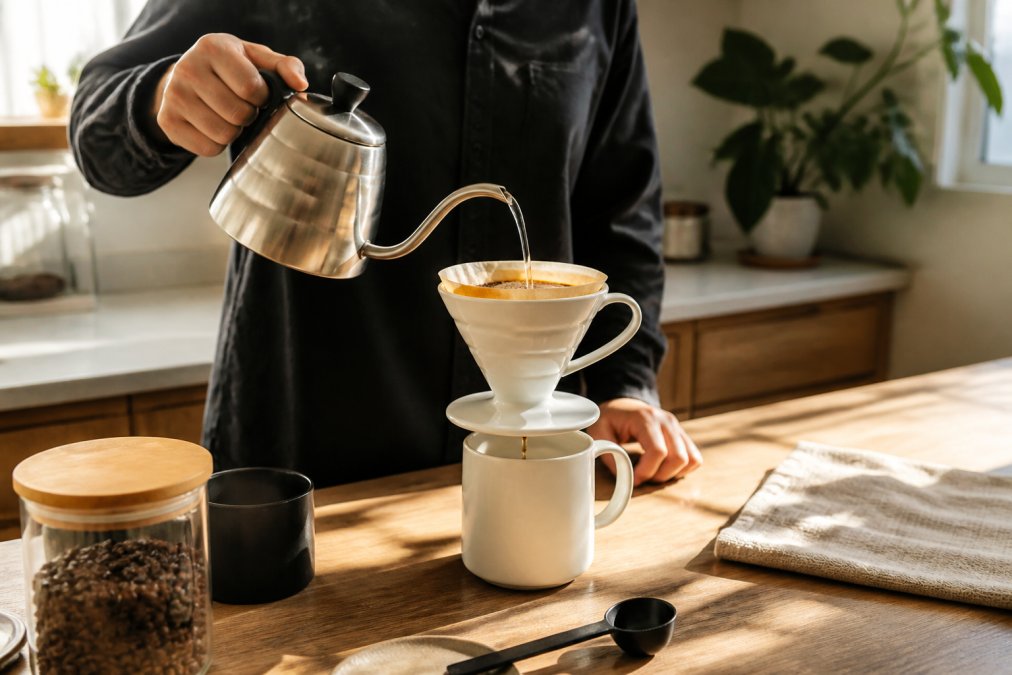
Pour-over brewing gives you direct control over extraction, water temperature, and brew time. This method highlights nuanced flavors in single-origin coffees and becomes a meditative part of your morning.
Equipment and Setup
You need a pour-over dripper, paper or metal filters, a gooseneck kettle for precise pouring, and a mug or carafe. The gooseneck kettle controls water flow, crucial for even extraction.
Grind your coffee fresh, just before brewing. Medium-fine grind works for most pour-over cones; grounds should feel like sand, not powder.
Heat water to 195-205°F. Boiling water over-extracts and tastes bitter; cooler water under-extracts and tastes sour. If you don't have a thermometer, let boiling water cool for 30 seconds.
Step-by-Step Brewing Process
Step 1: Prepare your dripper. Place a filter in the cone and rinse it with hot water. This removes paper dust and preheats the dripper. Discard the rinse water.
Step 2: Add grounds. Use a 1:16 coffee-to-water ratio: 25 grams of coffee to 400 grams of water. No scale? Use two tablespoons of grounds per six ounces of water.
Step 3: Bloom the grounds. Pour just enough hot water to wet the grounds, about twice the weight of the coffee. Wait 30-45 seconds. This releases carbon dioxide trapped in the grounds and improves extraction. You'll see the grounds puff up slightly.
Step 4: Pour in stages. Slowly pour water in a circular motion in three stages over 2-3 minutes.
French Press: Full-Immersion Brewing
A French press uses full-immersion brewing, meaning the coffee grounds sit in hot water for the entire brew time. This method extracts more oils and sediment than pour-over, creating a heavier body and richer mouthfeel. If you like bold, full-bodied coffee, French press is your method.
Why Full-Immersion Works
In a pour-over, water passes through grounds once. In a French press, grounds steep in water like tea, pulling more oils and flavor compounds. This is why French press coffee tastes thicker than drip coffee.
Brewing Steps and Timing
Step 1: Preheat the press. Pour hot water into the empty French press, swirl it around, and discard. This keeps the brew hot longer.
Best Coffee Grind Size for Beginners
Grind size is the single most important variable you control. It determines how fast water moves through the grounds, which controls extraction. Wrong grind size and your coffee tastes sour (under-extracted) or bitter (over-extracted). Get it right and everything else becomes easier.
Grind Size Chart by Method
| Brewing Method | Grind Size | Texture Comparison | Why This Size |
|---|---|---|---|
| French Press | Coarse | Breadcrumbs | Slows water flow; prevents over-extraction in long steep |
| Pour Over | Medium-Fine | Sand | Medium flow; balances extraction in 3-4 minute brew |
| AeroPress | Medium-Fine | Sand | Similar to pour-over; works with AeroPress's pressure |
| Moka Pot | Fine | Powdered sugar | Fast flow; creates pressure needed for stovetop brewing |
| Automatic Drip | Medium | Beach sand | Standard flow for machine's typical 8-10 minute cycle |
Coarse grind has large particles with less surface area; fine grind has small particles with more surface area. More surface area means faster extraction. In a French press, fast extraction would over-extract the coffee, so coarse grind is used.
How Grind Size Affects Extraction
Extraction dissolves flavor compounds from grounds into water. Under-extraction tastes sour and weak; over-extraction tastes bitter and harsh.
Single Origin Favorites Sample Pack →
Coffee Brewing Ratios for Beginners
The coffee-to-water ratio is your starting point. Most brewing guides recommend 1:16 (one part coffee to 16 parts water by weight).
The Standard Coffee-to-Water Ratio
The industry standard is 1:16: one gram of coffee to 16 grams of water. Without a scale, use two tablespoons of grounds per six ounces of water.
Adjusting Ratios for Your Taste
If your coffee tastes weak, move to a 1:15 ratio. If it tastes bitter, move to a 1:17 ratio.
AeroPress: Speed and Clarity Combined
An AeroPress brews in two to three minutes and produces a cup with clarity similar to pour-over but with more body than drip coffee. It's a hybrid: it uses immersion like a French press, then applies pressure like an espresso machine. The result is fast, clean, and forgiving.
What Makes AeroPress Different
An AeroPress is a plastic cylinder with a plunger. You add grounds, pour water, wait, then press down. The pressure forces water through grounds faster than gravity, allowing medium-fine grind without over-extraction.
Basic Brewing Technique
Step 1: Assemble the AeroPress. Screw the filter basket onto the bottom. Place a paper filter inside and rinse with hot water.
Step 4: Wait. Let it sit for one minute.
Moka Pot and Automatic Drip: Convenience Methods
Not every morning allows time for ritual. Moka pots and automatic drip machines prioritize speed and consistency. Both produce good coffee without requiring your full attention.
Stovetop Moka Pot Brewing
A Moka pot is a three-chamber device. Water in the bottom chamber heats up; steam pressure forces hot water through grounds in the middle chamber; brewed coffee collects in the top chamber.
Automatic Drip Coffee Makers
An automatic drip machine does everything for you. Add water, add grounds, press a button, wait. Eight to ten minutes later, your coffee is ready.
Common Mistakes to Avoid
The difference between mediocre home-brewed coffee and excellent home-brewed coffee often comes down to avoiding these five mistakes.
Frequently Asked Questions
What's the difference between immersion and drip brewing methods?
Immersion brewing (French press) steeps coffee grounds directly in hot water for several minutes, extracting flavor through prolonged contact. Drip brewing (pour-over, automatic drip) passes hot water through grounds, relying on gravity and draw-down time for extraction. Immersion typically produces fuller body and mouthfeel, while drip methods create cleaner, brighter cups with more flavor clarity. Choose immersion for bold, rich coffee and drip for lighter, more nuanced profiles.
How do I choose the right coffee brewing method for my taste preferences?
Start by considering the body and mouthfeel you prefer. If you enjoy full-bodied, bold coffee, try French press or Moka pot. For lighter, cleaner cups with more acidity and brightness, choose pour-over or automatic drip. AeroPress splits the difference, producing clean cups with good body. Also factor in time commitment: pour-over and AeroPress take 3-4 minutes, French press takes 4-5 minutes, while automatic drip and Moka pot require minimal hands-on time. Sample our Single Origin Favorites Sample Pack to test different roasts with your preferred method.
What's the best coffee grind size for beginners?
Medium grind is the safest starting point for most beginners. It works well with automatic drip makers and is forgiving of timing mistakes. For specific methods: use medium-fine grind for pour-over, coarse grind for French press, and fine grind for Moka pot. Grind size directly affects extraction time, finer grinds extract faster, coarser grinds extract slower. Invest in a basic burr grinder and adjust one notch at a time based on whether your coffee tastes bitter (too fine) or sour (too coarse).
What coffee-to-water ratio should I use?
The standard ratio is 1 part coffee to 16 parts water by weight. For example, use 25 grams of coffee to 400 grams (about 13.5 fluid ounces) of water. This ratio produces balanced extraction for most brewing methods. If you prefer stronger coffee, reduce to 1:15 ratio; for lighter coffee, increase to 1:17. Always measure by weight rather than volume for consistency. Our Best Sellers Sample Pack includes beans roasted to deliver excellent flavor across all standard ratios.
Is pour-over coffee difficult for beginners to learn?
Pour-over is beginner-friendly once you understand the basics. The key steps are: use medium-fine grind, bloom the grounds with a small amount of hot water for 30-45 seconds, then pour in circular motions over 2-3 minutes. Water temperature should be 195-205°F (90-96°C). The main challenge is consistency, practice the same pouring technique each time. A gooseneck kettle helps with control. Most beginners master pour-over within a few attempts, and the method rewards attention to technique with excellent flavor clarity.