

Water Quality's Impact on Home Brewed Coffee
Table of Contents
- Why Water Quality Matters for Your Coffee
- The Chemistry Behind Water and Coffee Extraction
- Hard Water vs. Soft Water: What's the Difference?
- How to Test Water Hardness for Coffee
- Best Water for Coffee Brewing
- Filtration Methods to Improve Your Brewing Water
- SCA Water Quality Standards for Coffee
- Putting It All Together: Your Water-to-Coffee Action Plan
- Frequently Asked Questions
Last Updated: September 28, 2026
Why Water Quality Matters for Your Coffee
The coffee in your cup is 98% water, which is why water quality coffee depends entirely on what's in that water. That single fact should tell you everything about why water quality deserves serious attention. Most home brewers obsess over beans, grind size, and brewing technique, then ignore the one ingredient that makes up nearly the entire drink. It's the easiest lever you have to improve flavor, and it costs almost nothing to pull.
Many home brewers buy premium beans and perfect their technique, only to find cups that taste flat or bitter. The culprit is often tap water, loaded with minerals, chlorine, or mineral deficiencies that sabotage extraction. Addressing water quality transforms results immediately, unlocking the complexity those beans should deliver.
Water quality coffee performance depends on how well the water affects extraction efficiency, flavor clarity, and equipment longevity. Poor water either extracts too little (sour, thin coffee) or too much (bitter, harsh flavors). The right water dissolves desirable compounds while leaving harsh ones behind.
The Chemistry Behind Water and Coffee Extraction
Coffee extraction is a dissolution process where hot water pulls soluble compounds from grounds. Water's ability to dissolve those compounds depends on what's already dissolved in it, pure water is a better solvent than mineral-saturated water. This explains why tap water often sabotages extraction.
Total Dissolved Solids and Flavor
Total Dissolved Solids (TDS) measures the concentration of dissolved minerals in water, expressed in parts per million (ppm). This number directly impacts extraction and mouthfeel.
Water under 50 ppm TDS extracts too aggressively, pulling harsh compounds and producing thin, sour coffee. Water over 300 ppm extracts too slowly, leaving coffee weak and underdeveloped.
The Specialty Coffee Association (SCA) recommends 75-200 ppm TDS for optimal extraction. Espresso machines prefer the lower end, while immersion methods like French press handle slightly higher TDS.
Alkalinity, pH Balance, and Mouthfeel
Alkalinity refers to water's capacity to resist pH changes, primarily from dissolved bicarbonate. High alkalinity buffers coffee's natural acidity, muting bright notes and creating flat mouthfeel. Low alkalinity allows acids to shine but can make the cup taste thin and sharp.
The SCA recommends 40-80 ppm alkalinity as bicarbonate and pH between 6.5-7.5. Below 40 ppm alkalinity, brightness becomes harshness. Above 80 ppm, coffee tastes muddy. Acidic water (below 6.5) corrodes equipment and produces sour coffee. Alkaline water (above 7.5) suppresses extraction.
Hard Water vs. Soft Water: What's the Difference?
Water hardness is determined by dissolved calcium and magnesium ions. These minerals accumulate in your equipment, build scale, and affect how extraction occurs. Understanding your water's hardness profile is essential for both flavor and machine longevity.
How Calcium and Magnesium Affect Your Cup
Calcium and magnesium are the primary minerals that define water hardness. Hard water (high in these minerals) creates scale buildup in your equipment and can suppress extraction. Soft water (low in these minerals) allows faster extraction but may lack the mineral ions needed for proper flavor development.
The relationship is counterintuitive: some magnesium in your water actually improves flavor. Magnesium enhances sweetness and body, while calcium contributes to clarity and brightness.
Scale Buildup and Equipment Damage
Scale (calcium and magnesium carbonate) forms when hard water is heated, reducing water flow and equipment lifespan. In espresso machines, it reduces pressure and creates uneven extraction. In kettles, it accumulates on heating elements. Repeated exposure eventually requires professional servicing or replacement. Water hardness between 100-150 ppm is the practical sweet spot: soft enough to minimize scale, hard enough to support extraction.
How to Test Water Hardness for Coffee
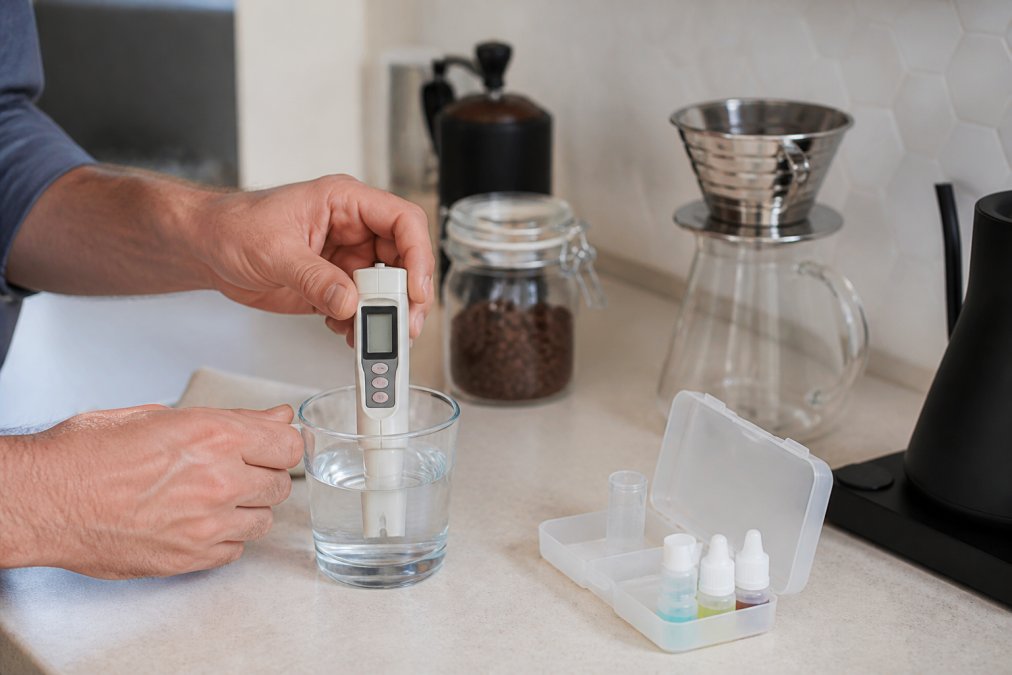
Testing your water reveals what you're working with and guides your filtration strategy. Three practical approaches: reading your local water report, using a TDS meter, or conducting a hardness test at home.
Reading Your Local Water Report
Your municipal water utility publishes an annual Consumer Confidence Report (CCR) containing total hardness, alkalinity, pH, mineral composition, and TDS. It's free and usually accessible on your city or county water department's website.
Look for these specific values:
Single Origin Favorites Sample Pack →
- Total hardness (expressed in ppm or mg/L)
- Alkalinity (as ppm bicarbonate)
- pH
- Calcium and magnesium concentrations
- Chlorine or chloramine levels
DIY Testing Methods and Tools
A TDS meter ($15-30) measures total dissolved solids in seconds and shows whether your water falls within the 75-200 ppm extraction window. A water hardness test kit ($10-20) uses chemical reagents to confirm whether water is soft, moderately hard, or very hard. For pH, pH strips are cheap but less accurate; a digital pH meter ($20-40) provides precise readings.
Best Water for Coffee Brewing
The ideal brewing water isn't pure or soft, it's balanced. The SCA defines optimal water for coffee as having specific mineral content, alkalinity, and pH. Understanding these standards helps you evaluate whether your tap water needs treatment and what type of treatment makes sense.
Mineral Content and Flavor Clarity
The SCA's recommended water profile includes:
- Total hardness: 50-150 ppm (ideally 100-150 ppm)
- Alkalinity: 40-80 ppm
- pH: 6.5-7.5
- Chlorine: 0 ppm (should be removed)
- Sodium: below 30 ppm
This profile balances extraction efficiency with flavor development. The mineral content supports proper dissolution of coffee compounds. The alkalinity buffers natural acidity without suppressing it. The pH allows acids and sugars to express themselves fully.
Water Chemistry for Specific Brew Methods
Different brewing methods tolerate different water profiles. Understanding these nuances helps you optimize your specific setup.
Filtration Methods to Improve Your Brewing Water
If your tap water falls outside SCA standards, filtration or mineral adjustment brings it into range. Different filtration methods address different problems. Choosing the right one depends on what your water report reveals.
Carbon Filtration and Chlorine Removal
Activated carbon filters remove chlorine, chloramine, and organic compounds but don't remove minerals or reduce hardness. They cost $10-30 for pitcher filters or $50-150 for under-sink systems. Use carbon first if you need multiple filtration types. Pitcher filters require frequent replacement; under-sink filters last longer and suit regular brewing better.
Reverse Osmosis and Ion Exchange Systems
Reverse osmosis (RO) removes nearly all dissolved solids and contaminants, producing very soft water (5-10 ppm TDS) that requires remineralization. An RO system with remineralization costs $150-400 installed. Use RO if water is very hard (over 300 ppm) or contaminated. The downside: RO systems discharge 3-4 gallons of wastewater per gallon filtered.
| Filtration Method | Cost | Best For | What It Removes |
|---|---|---|---|
| Pitcher carbon filter | $10-30 | Chlorine removal, casual brewing | Chlorine, some organics |
| Under-sink carbon | $50-150 | Regular brewing, chlorine/taste issues | Chlorine, chloramine, taste/odor |
| Ion exchange cartridge | $30-80 | Scale prevention, moderately hard water | Calcium, magnesium (softening) |
| Reverse osmosis system | $150-400 | Very hard water, contamination concerns | Nearly all dissolved solids |
| Whole-house softener | $500-1500 | Scale prevention across all equipment | Calcium, magnesium (entire home) |
SCA Water Quality Standards for Coffee
The Specialty Coffee Association publishes detailed water quality guidelines that define optimal brewing water. These standards are based on extraction science and flavor development research. Understanding them helps you evaluate whether your water needs adjustment and what target you're aiming for.
Putting It All Together: Your Water-to-Coffee Action Plan
Improving your brewing water doesn't require expensive equipment. Start with measurement, identify your problem, and apply the simplest fix.
Frequently Asked Questions
What's the ideal mineral content for brewing coffee?
The Specialty Coffee Association (SCA) recommends 75-250 parts per million (ppm) of total dissolved solids for optimal extraction. Within that range, aim for 40-80 ppm of calcium and magnesium combined. This mineral balance ensures proper solubility of coffee's flavor compounds while preventing scale buildup on equipment. Water below 75 ppm tastes flat; above 250 ppm can feel heavy and bitter.
Should I use filtered or distilled water for my coffee?
Filtered water is better than distilled. Distilled water lacks minerals entirely, resulting in poor extraction and flat flavor. Filtered water removes chlorine and chloramine (which create off-tastes) while retaining beneficial mineral ions like calcium and magnesium. Use a carbon filter for chlorine removal, or a reverse osmosis system if your tap water is very hard. Aim for water in the 75-250 ppm range.
How does water hardness affect coffee flavor profiles?
Hard water contains high levels of calcium and magnesium ions, which buffer acidity and enhance sweetness and body, good for bright, acidic beans. Soft water brings out bitterness and can taste thin because minerals aren't present to balance extraction. Very hard water causes scale buildup, damages equipment, and can produce muddy, over-extracted flavors. Test your water hardness (parts per million of hardness minerals) to match it with the right roast profile.
Can poor water quality damage my coffee brewing equipment?
Yes. Hard water deposits mineral scale inside kettles, espresso machines, and coffee makers, reducing heat transfer and clogging spray heads. Over time, scale buildup forces equipment to work harder, shortening its lifespan. Chlorine and chloramine corrode metal components. Using filtered water and descaling regularly prevents damage. If your tap water exceeds 150 ppm hardness, consider a filtration system to protect your investment in quality brewing gear.
Water quality is the foundation of great coffee. It's the variable you control most easily, yet it's the one most home brewers ignore. Your tap water is probably sabotaging your brew in ways you don't realize. Measure it, adjust it, and watch your coffee transform. The investment is minimal, the improvement is profound.