

Best Coffee Beans for French Press Brewing
Table of Contents
- Understanding Roast Profiles for French Press
- The Importance of Grind Size Consistency
- Coarse vs Fine Grind for French Press
- French Press Coffee Ratio and Water Temperature
- Best Roast for French Press: Single-Origin and Blends
- Whole Bean vs. Pre-ground Coffee
- How to Achieve a Smooth, Non-Bitter Cup
- Frequently Asked Questions
Last Updated: September 26, 2026
Understanding Roast Profiles for French Press
The best coffee beans for French press brewing require a specific roast profile suited to immersion brewing. Without paper filters, coffee oils and sediment remain in your cup, fundamentally changing which roasts perform best.
Medium to dark roasts excel in French press because they develop the full-bodied, rich flavors that immersion brewing extracts effectively. Light roasts taste thin or overly acidic when brewed this way; dark roasts bring the complexity and smoothness that shine through French press's full-bodied mouthfeel.

Roast profiles matter more than bean origin when selecting for French press. A well-roasted medium-dark bean from any origin outperforms a poorly-roasted light roast from the finest farm. The roasting process determines oil development on the bean surface, and those oils give French press its signature richness.
The Importance of Grind Size Consistency
Grind size consistency directly controls extraction speed and flavor balance in French press. Inconsistent sizes cause fine particles to over-extract into bitterness while coarse particles under-extract into weakness. A burr grinder produces uniform particle size and solves this problem.
Blade grinders create wildly inconsistent grind sizes by chopping randomly rather than cutting at a precise setting. This inconsistency is the primary reason French press coffee tastes muddy or bitter. A burr grinder (conical or flat) cuts each bean to the same size, ensuring even extraction.
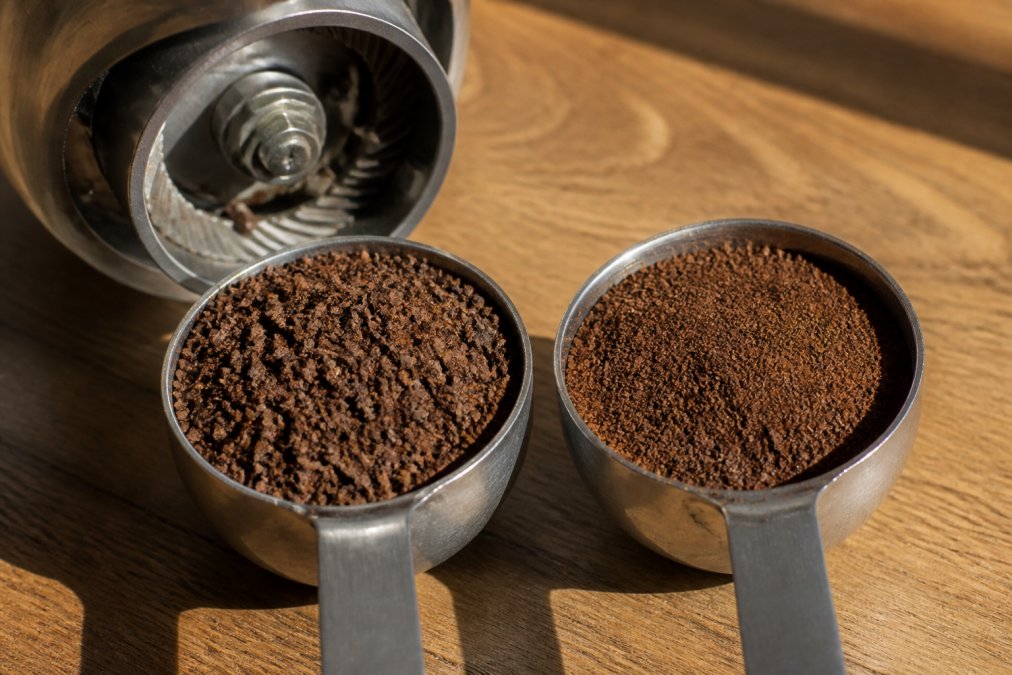
Coarse vs Fine Grind for French Press
A coarse grind is non-negotiable for French press. The grind size should resemble sea salt or breadcrumbs, particles large enough that you can see individual pieces. This prevents fine sediment from clogging the mesh filter and keeps your cup clean.
Fine grind passes through the mesh screen and settles as sediment, accelerating extraction and pulling too much bitterness within the 4-minute steeping window. Coarse grind slows extraction to match brewing time, giving you control over flavor intensity.
French press's 4-minute brew time is calibrated for coarse grind. Fine grounds extract in 2-3 minutes and over-extract; coarse grounds need 4-5 minutes to reach optimal extraction.
Grinder consistency matters more than grinder type. A burr grinder set to coarse produces uniform particles; a blade grinder produces chaotic mix with fine dust that ruins the cup.
French Press Coffee Ratio and Water Temperature
The standard ratio for French press is 1 part coffee to 15-17 parts water by weight. This translates to roughly 1 ounce of coffee per 15 ounces of water, or about 0.6 ounces per 8-ounce cup. This ratio produces a full-bodied, balanced cup without excessive strength or weakness.
Water temperature should be 195-205°F. Hotter water over-extracts and amplifies bitterness; cooler water under-extracts and leaves the cup thin. Boil water and let it cool 30 seconds before pouring to prevent burnt-tasting coffee.
The bloom phase matters more in French press than drip brewing. Pour just enough hot water to saturate the grounds (roughly twice the weight of dry coffee), wait 30-45 seconds, then pour the remaining water to allow CO2 to escape and ensure even extraction.
Best Roast for French Press: Single-Origin and Blends
Bean origin and processing method matter equally to roast profile for French press because they determine natural oil content and how oils behave during immersion extraction.
How Altitude and Processing Affect French Press Extraction
Single-Origin Beans for French Press
Blends Designed for Immersion Brewing
The Processing Method Trade-off
Whole Bean vs. Pre-ground Coffee
Whole bean coffee stays fresh 2-4 weeks after roasting. Pre-ground coffee loses freshness within days because grinding increases surface area, allowing oxygen to degrade flavor compounds and aromatic oils.
Grinding immediately before brewing preserves aroma and flavor. The bloom phase releases trapped CO2; with pre-ground coffee, much CO2 has already escaped during storage, losing aromatic complexity.
Freshness is critical for French press, where full-bodied extraction amplifies both positive and negative flavors. Stale pre-ground coffee tastes flat and woody; fresh whole beans ground just before brewing taste vibrant and complex.
Grinding takes 90 seconds with a burr grinder. The flavor improvement is worth the time investment for French press.
How to Achieve a Smooth, Non-Bitter Cup
Bitterness comes from over-extraction, but smoothness depends on water chemistry as much as brewing technique. Water mineral content is the missing variable that explains why identical beans and technique produce different results in different locations.
Extraction Control: Grind, Temperature, and Time
Start with coarse grind and 4-minute steeping time. If the cup tastes thin, increase the coffee-to-water ratio slightly (1:17 to 1:15). If bitter, reduce steeping time by 30 seconds or use cooler water (190-195°F). Never adjust grind size to fix extraction; it creates inconsistency that compounds the problem.
Water temperature is the most sensitive variable. Water at 205°F extracts faster and pulls more bitter compounds from the beans. Water at 195°F extracts more slowly and produces a smoother, sweeter cup. If your tap water boils at a lower temperature due to altitude (above 5,000 feet), adjust your target temperature downward by 2-3°F for every 1,000 feet of elevation.
The plunger technique directly affects smoothness. Press slowly and steadily over 10-15 seconds rather than plunging hard and fast. A rapid plunge forces fine sediment through the mesh screen, which clouds the cup and adds harsh, gritty flavors. A slow, controlled press leaves sediment at the bottom and produces a cleaner, smoother cup. This technique matters more than most guides acknowledge because it's the difference between a silky mouthfeel and a scratchy one.
Water Chemistry and Oil Extraction: The Smoothness Factor
Testing Your Water and Adjusting Brew Variables
Combining Technique and Water Chemistry
Smooth, non-bitter French press requires three things working together: (1) coarse grind from a burr grinder for consistent extraction, (2) water temperature between 195-205°F with a 4-minute steep time, and (3) water chemistry that supports oil suspension, typically moderately hard or filtered water. Get all three right and even medium-roast beans produce a smooth, full-bodied cup. Miss any one of them and the cup tastes thin, bitter, or chalky regardless of bean quality.
Frequently Asked Questions
What type of coffee beans are best for brewing in a French press?
Medium to dark roast whole beans work best for French press brewing. The immersion method requires beans that can withstand longer steeping times without becoming excessively bitter. Single-origin beans with full-bodied profiles and lower acidity, such as those with dark chocolate, earthy, or syrupy body notes, deliver smooth, rich cups. Avoid very light roasts, which can taste thin and sour in a French press.
Is coarse or fine ground coffee better for a French press?
Coarse grind is essential for French press brewing. Fine grounds pass through the metal mesh filter, creating sediment and a gritty mouthfeel. Coarse grind allows proper extraction during the 4-minute immersion while keeping sediment out of your cup. Grind consistency matters as much as coarseness, uneven grinds lead to over-extraction of fine particles and under-extraction of larger ones, affecting flavor clarity and mouthfeel.
What is the ideal French press coffee ratio?
A standard French press coffee ratio is 1:15 (one part coffee to 15 parts water by weight). For example, use 30 grams of coffee to 450 milliliters of water for a typical 12-ounce cup. This ratio produces a full-bodied, balanced brew. Adjust to 1:14 for stronger coffee or 1:16 for lighter extraction. Using filtered water prevents mineral buildup and ensures clean flavor notes without interfering tannins.
Does roast level affect the flavor profile in a French press?
Yes, roast level significantly impacts flavor. Medium roasts preserve origin characteristics and acidity, highlighting fruit and floral notes. Medium-dark roasts develop deeper chocolate, caramel, and spice flavors with reduced acidity. Dark roasts deliver heavy, oily, bold profiles with minimal origin distinction. For French press, medium to medium-dark roasts offer the best balance, they resist the bitterness that can develop during long immersion brewing while maintaining complexity and aroma.