

Best Ways to Brew Single Origin Coffee
Table of Contents
- Understanding Single Origin Coffee and Brewing Fundamentals
- How to Grind Coffee for Single Origin Beans
- Best Coffee-to-Water Ratio for Pour Over
- Impact of Water Temperature on Coffee Extraction
- Pour-Over Brewing Technique for Single Origin
- French Press and AeroPress Methods
- Matching Brewing Method to Processing Type
- Common Mistakes to Avoid When Brewing Single Origin
Last Updated: August 25, 2026
Understanding Single Origin Coffee and Brewing Fundamentals
Single origin coffee refers to beans sourced from a specific farm, region, or country, rather than blended from multiple origins. When you brew single origin coffee, you're highlighting the unique characteristics that terroir, altitude, processing method, and varietals imprint on each bean. At Cenia's Coffee, understanding these fundamentals transforms how you approach brewing, because the best ways to brew single origin beans depend on what you're trying to extract from them.

A washed Ethiopian natural process bean tastes nothing like a wet-hulled Sumatran. Brewing the same way for both wastes the potential of at least one of them. Most home brewers don't adjust their method based on the bean's origin, processing, or roast level. That's where improvement begins.
How to Grind Coffee for Single Origin Beans
The grind is where most home brewers lose control. Inconsistent particle size creates uneven extraction, some grounds over-extract while others under-extract, muddying the cup. For single origin beans, consistency matters even more because you're trying to preserve specific flavor notes.
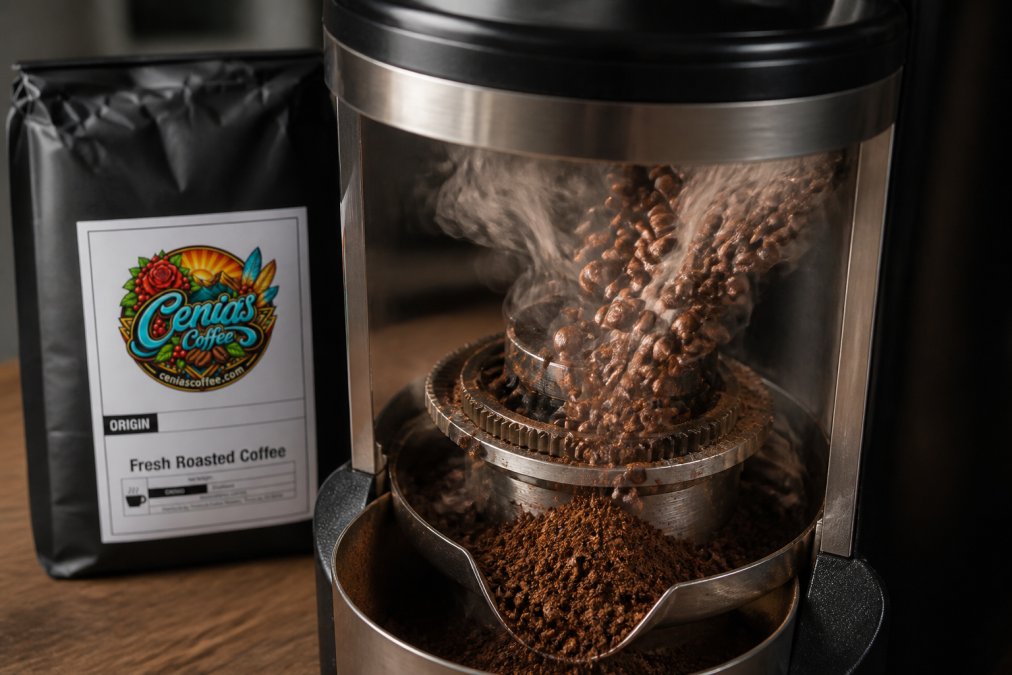
Burr grinders, either conical or flat burr designs, produce more uniform particle distribution than blade grinders. If you're investing in quality single origin beans, a burr grinder is non-negotiable. Many coffee enthusiasts find that upgrading their grinder delivers more improvement than upgrading their brewing equipment.
Grind size distribution affects how water moves through the coffee bed. A tighter, more uniform distribution means water contacts particles more evenly, leading to more predictable extraction. This is especially important for pour-over and French press methods, where you control the water-to-coffee contact time directly.
The relationship between grind size and brew method is direct:
- Pour-over (paper or metal filter): medium-fine grind, particles roughly the size of sea salt
- French press: coarse grind, particles closer to breadcrumbs
- AeroPress: medium grind, adjustable based on brew time preference
- Moka pot: fine grind, similar to espresso but slightly coarser
A common mistake is grinding too fine, thinking finer = stronger. Finer grind increases surface area and extraction speed. If you're already using a standard brew time, grinding finer often means over-extraction and bitterness. Adjust your brew time when you adjust your grind.
Best Coffee-to-Water Ratio for Pour Over
The brew ratio, the proportion of coffee to water, is one of the easiest variables to control and one of the most impactful. Most specialty coffee professionals use a ratio of 1:16 or 1:17 (one part coffee to 16-17 parts water by weight) (sca.coffee). This ratio works well as a starting point for most single origin beans.
For lighter roasts with high acidity and floral notes, many brewers prefer ratios closer to 1:15 or even 1:14, which increases coffee concentration and brings forward the bean's brightness. For darker roasts with heavier body and chocolate notes, ratios of 1:17 or 1:18 allow more water contact and soften harsh edges.
A practical example: if you're brewing with 20 grams of coffee, a 1:16 ratio means 320 grams of water. Weigh both on a kitchen scale. This precision is where the difference between an average cup and an exceptional one becomes obvious.
| Brew Ratio | Best For | Resulting Cup |
|---|---|---|
| 1:14 to 1:15 | Light roasts, floral/bright origins | Concentrated, acidic, flavor-forward |
| 1:16 (standard) | Most single origins, balanced profile | Full-bodied, balanced, versatile |
| 1:17 to 1:18 | Dark roasts, heavy bodies | Smooth, mellow, less acidity |
Water temperature interacts with your ratio. Hotter water extracts faster, so very hot water with a standard ratio might over-extract. Cooler water extracts slower, so you might need a slightly tighter ratio or longer contact time. You're aiming for roughly 18-22% extraction, which means 18-22% of the coffee's soluble material ends up in your cup (sca.coffee).

Impact of Water Temperature on Coffee Extraction
Water temperature controls extraction speed more directly than any other variable. Hotter water dissolves coffee's soluble compounds faster. Cooler water extracts more slowly, allowing you finer control over what gets into your cup.
The ideal range for most single origin beans falls between 195-205°F (sca.coffee). This temperature range balances extraction speed with flavor clarity. Many home brewers use water just off boil, around 200-205°F, which works well for most applications. For light roasts with delicate floral notes, starting at 200°F and letting the water cool slightly during the brew can preserve brightness. For darker roasts, 205°F helps extract the fuller body.
Water temperature drops during brewing. If you start at 205°F and your brew takes 4 minutes, your slurry temperature will have dropped 10-15°F by the end. This creates a natural progression from faster to slower extraction, which tends to produce cleaner, more balanced cups.
Thermal stability, how well your brewing vessel maintains temperature, affects consistency. A pre-warmed ceramic or glass brewer holds heat better than a cold one. Pre-rinse your dripper with hot water before brewing.
Water chemistry also influences extraction. Hard water (high mineral content) tends to extract faster, while very soft water extracts slower. Cenia's Coffee beans are roasted to work with standard tap water chemistry, but understanding your local water helps you dial in your technique.
Pour-Over Brewing Technique for Single Origin
Pour-over brewing gives you the most control over extraction variables. You control water temperature, pour rate, bloom time, and total contact time. This precision is why specialty coffee professionals often prefer pour-over for evaluating single origin beans.
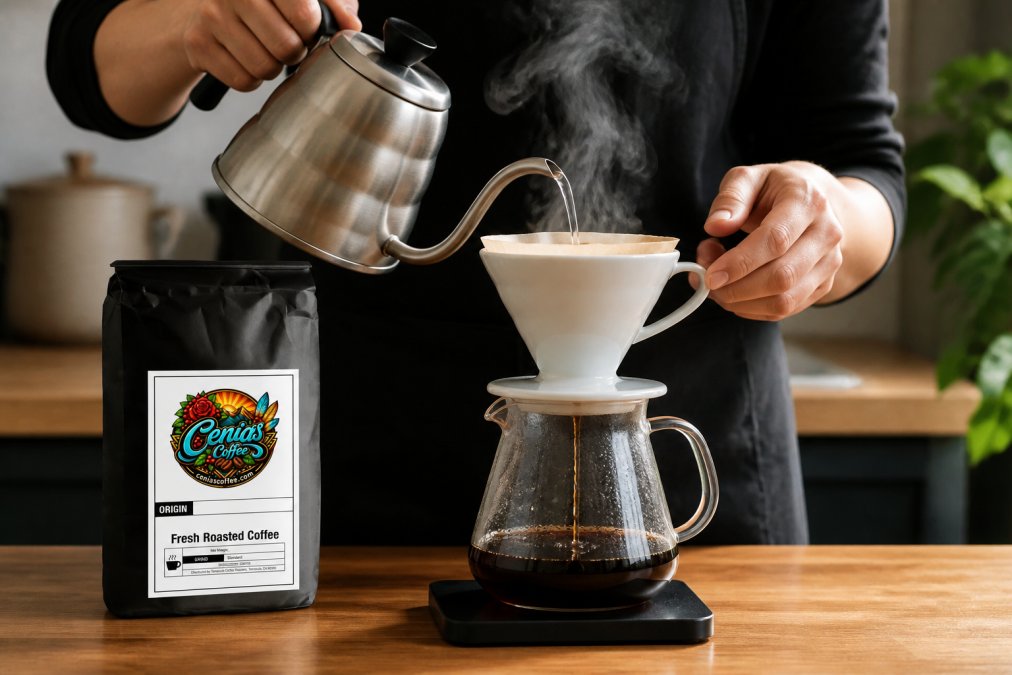
The basic sequence is bloom, main pour, and draw-down.
The Bloom Phase and Agitation
The bloom phase is the first 30-45 seconds when you pour just enough water to saturate the grounds. For a 20-gram pour-over, that's roughly 40 grams of water. This initial contact allows CO2 trapped in the grounds to escape. If you skip the bloom or rush through it, CO2 bubbles create channels in the grounds, allowing water to bypass some coffee particles, leading to uneven extraction.
During the bloom, the grounds should expand visibly and the water should darken quickly. Agitation during the bloom matters. Some brewers stir gently with a spoon or swirl the dripper to ensure even saturation. The goal is uniform contact between water and grounds. Distribute the bloom water evenly across the grounds rather than pouring in one spot.
Draw-Down Time and Slurry Temperature
After the bloom, the main pour begins. Pour in a steady, controlled manner, maintaining a consistent water level in the dripper. Most pour-overs finish in 3-4 minutes total. If your brew finishes in under 2 minutes, your grind is too coarse or your pour rate is too fast. If it takes over 5 minutes, your grind is too fine or your water is too cool.
The draw-down time directly affects extraction. A faster draw-down means less contact time, which can under-extract light, delicate beans. A slower draw-down means more contact time, which can over-extract and create bitterness. The sweet spot for most single origins is 3-4 minutes total brew time, with the slurry temperature dropping gradually to roughly 160-170°F by the end.
Your pour doesn't need to be perfect, it needs to be repeatable. If you pour the same way every time, you can dial in your grind and ratio to match your technique. Consistency beats perfection.
French Press and AeroPress Methods
French press brewing is immersion-based, meaning grounds sit in water for the entire brew time. This method extracts differently than pour-over because water contacts grounds continuously. French press typically produces fuller body and heavier mouthfeel because the metal mesh filter allows fine particles and oils to pass through.
For French press, use a coarse grind with visibly distinct particles. The standard ratio is 1:15 or 1:16. Add grounds to the pot, pour water at 200-205°F, stir gently after 30 seconds, then let it sit for 4 minutes. Press slowly over 20-30 seconds. Pour your cup immediately after pressing, or decant the remaining coffee into another vessel to stop extraction.
AeroPress brewing sits between pour-over and French press in terms of control and immersion time. It uses air pressure to force water through finely ground coffee in 30-60 seconds. This rapid extraction method works well for single origins because the short contact time preserves clarity and brightness. Use a medium-fine grind and a 1:16 ratio. The AeroPress is forgiving and produces clean cups because the paper filter removes oils and fine particles. It's an excellent method for dialing in new beans because you can adjust grind size and brew time easily.
Matching Brewing Method to Processing Type
The way a coffee bean is processed shapes its flavor profile and how it behaves during extraction. Matching your brewing method to the processing type amplifies the bean's intended characteristics.
Washed process coffees are cleaned thoroughly after harvesting, removing the fruit before drying. This produces cleaner flavor clarity and higher acidity. Washed coffees shine in pour-over brewing because the clean cup highlights the bean's origin characteristics. Cenia's Coffee Tanzania, a washed coffee, displays pear and floral notes best through pour-over.
Natural process coffees are dried with the fruit still attached, creating heavier body, higher sweetness, and fruity tones. These beans benefit from immersion brewing like French press, which allows the fuller body to develop without over-emphasizing acidity. The Ethiopia Natural from Cenia's Coffee reveals its milk chocolate and fruity character through French press or AeroPress better than pour-over.
Honey process removes the skin but leaves some mucilage during drying. This creates a middle ground between washed and natural, balanced acidity with added sweetness and body. Honey process coffees work well with both pour-over and AeroPress.
Wet-hulled, unique to Indonesia, is hulled while still wet, then dried. This creates earthy, herbal notes with syrupy body and low acidity. Cenia's Coffee Sumatra, with its dark chocolate and dried fruit profile, excels in French press where the immersion time brings forward the syrupy body.

Cleaner processing methods pair well with precision brewing (pour-over, AeroPress), while fruit-forward processing methods pair well with immersion brewing (French press).
Common Mistakes to Avoid When Brewing Single Origin
Mistake 1: Inconsistent grind size. Using a blade grinder or not maintaining your burr grinder creates uneven extraction. Invest in a quality burr grinder and use it consistently.
Mistake 2: Incorrect water temperature. Water that's too cool (under 190°F) under-extracts and produces thin, sour cups. Water that's too hot (over 210°F) over-extracts and creates bitterness. Use a thermometer until you develop a feel for it.
Mistake 3: Ignoring the bloom phase. Skipping the bloom or rushing through it allows CO2 to create channels in the grounds, leading to inconsistent extraction. Spend 30-45 seconds on the bloom.
Mistake 4: Changing multiple variables at once. If your cup tastes off, change one variable, brew again, and evaluate. This is how you learn what each variable actually does.
Mistake 5: Not weighing your coffee and water. Eyeballing ratios introduces enough variance that you can't distinguish between a brewing technique problem and a ratio problem. A kitchen scale costs $15 and eliminates this guessing game.
Mistake 6: Not adjusting for your beans' roast profile. Light roasts need slightly hotter water and shorter brew times. Dark roasts benefit from slightly cooler water and longer brew times. Cenia's Coffee includes roast notes on each single origin; use them as starting points for your technique.
The underlying pattern is that single origin brewing rewards consistency and intentionality. You don't need expensive equipment or complex techniques. You need to control the variables you can control and adjust them purposefully.
Brewing single origin coffee well comes down to understanding how each variable, grind, ratio, temperature, time, affects extraction. The best ways to brew single origin coffee are the ones that match the bean's processing and roast profile. Cenia's Coffee offers single origins like Kenya (bright acidity, fully washed), Uganda (mild acidity, floral), and Sumatra (syrupy body, wet-hulled), each designed to shine when brewed intentionally. Start with the Single Origin Favorites Sample Pack to explore how processing differences taste in your own setup. Once you've found the origins you love, dial in your technique, consistent grind, measured ratios, and attention to temperature, and you'll taste the difference that quality beans and intentional brewing make.
Frequently Asked Questions
What is the ideal coffee-to-water ratio for brewing single origin coffee?
The standard ratio is 1:16 (one part coffee to 16 parts water by weight), which works well for most single origin beans. Adjust based on your taste preference: use 1:15 for a stronger cup or 1:17 for a lighter, more delicate extraction. This ratio helps highlight the unique flavor notes and tasting characteristics specific to each single origin's processing method and altitude.
Why is water temperature critical when brewing single origin beans?
Water temperature directly controls extraction yield and flavor development. For single origin coffees, aim for 195-205°F (90-96°C). Temperatures below 195°F result in under-extraction, producing sour, thin coffee with muted acidity and body. Temperatures above 205°F cause over-extraction, creating bitter, harsh flavors that mask the bean's unique characteristics. Lighter roasts benefit from slightly higher temperatures to achieve full extraction, while darker roasts work better at the lower end to avoid excessive bitterness.
How does grind size affect the taste of single origin coffee?
Grind size controls contact time between water and coffee grounds, directly impacting extraction. Coarser grinds (for French press) produce fewer contact points, requiring longer steeping times and resulting in fuller body and mouthfeel. Finer grinds (for pour-over) increase surface area, allowing faster extraction and brighter acidity. Single origin beans reveal their processing character through grind choice: washed coffees typically show cleaner, more acidic profiles with medium-fine grinds, while natural process beans express fruity, syrupy notes better with slightly coarser settings.
What is the best brewing method to highlight single origin flavor profiles?
Pour-over brewing offers the most control for showcasing single origin characteristics. The bloom phase allows gases to escape, improving water penetration and extraction evenness. You can adjust pour rate, water temperature, and contact time to emphasize specific tasting notes. For washed process beans with bright acidity, pour-over creates clarity. For natural process beans with heavier body and fruit-forward notes, immersion methods like French press work well. The Single Origin Favorites Sample Pack from Cenia's Coffee includes six distinct origins, try each with pour-over first to experience their full flavor potential before experimenting with other methods.
This article was written using GrandRanker