

Best Coffee Subscription for Small Households in 2026
Table of Contents
- Why Small Households Need a Different Coffee Subscription Strategy
- Quick Comparison: Best Coffee Subscription Options for One or Two Drinkers
- Best for Exploring: Single Origin Favorites Sample Pack
- Best for Flavor Variety: Flavored Coffees Sample Pack
- Best for Convenience: Single Serve Capsules and Instant Coffee
- Coffee Subscription Frequency for One Person: How to Avoid Stale Beans
- How to Store Coffee Beans for Maximum Freshness in Small Spaces
- How We Evaluated These Coffee Subscriptions
- Frequently Asked Questions
Last Updated: September 5, 2026
Finding the best coffee subscription for small households isn't about chasing the biggest bag or the lowest per-pound price. For one or two drinkers, the real challenge is maintaining freshness before a 12-ounce bag goes stale, which typically happens a few weeks after the roast date. At Cenia's Coffee, we've built our roasting and packaging model around this exact problem, and in this guide, we break down how to match a coffee subscription to your actual consumption volume.
Most subscription guides assume you're powering through a bag a week. That advice falls apart when you brew two cups a day or only on weekends. The best coffee subscription for small households prioritizes smaller quantities, shorter delivery windows, and storage-friendly packaging over sheer volume discounts.
Why Small Households Need a Different Coffee Subscription Strategy
The standard coffee subscription model ships a 12-ounce bag monthly, which works for households drinking four or more cups daily. When you're brewing for one or two people, that same bag lingers past its peak flavor window. Coffee's aroma, body, and tasting notes degrade noticeably after the beans are exposed to air, so a subscription designed for a single drinker must account for slower consumption rates.
Ordering sample packs or smaller quantities more frequently keeps your supply freshly roasted and lets you rotate through roast profiles without waste, while avoiding over-ordering to justify shipping costs.
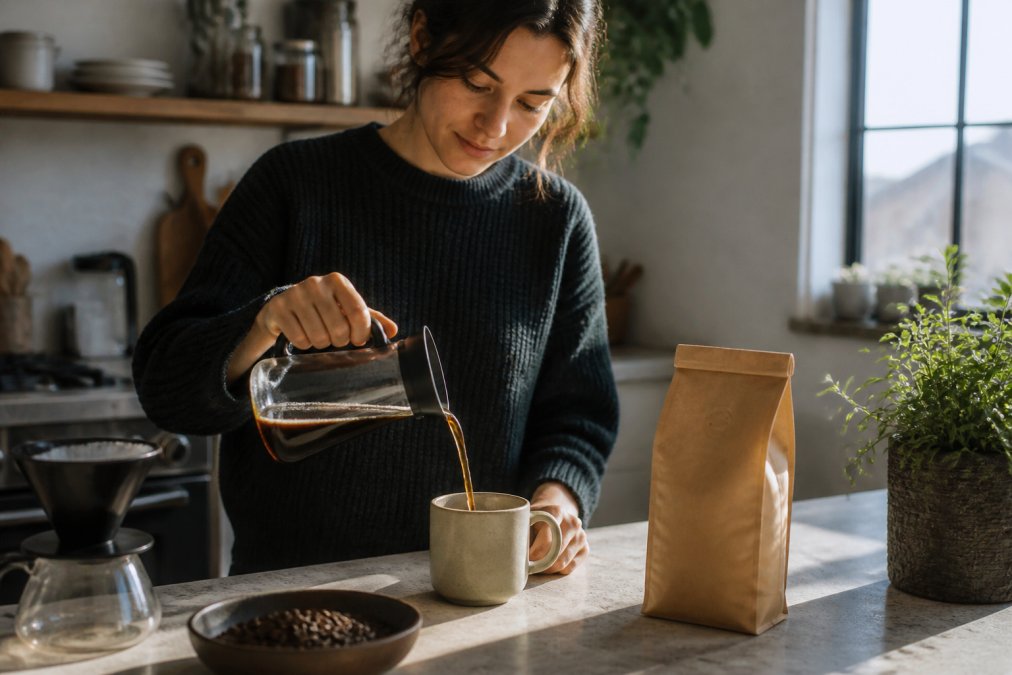
A 2-ounce sample format solves the freshness equation entirely: you open a new pack every few days, so every cup lands within the optimal window after roasting. Storage becomes simpler too, since you're never holding open bags for weeks.
Quick Comparison: Best Coffee Subscription Options for One or Two Drinkers
| Option | Best For | Format | Price | Freshness Approach |
|---|---|---|---|---|
| Single Origin Favorites Sample Pack | Exploring origins and tasting notes | Six 2oz packs | $24.99 | Open one pack at a time |
| Flavored Coffees Sample Pack | Flavor variety without commitment | Six 2oz packs | $24.99 | Small-batch roasted to order |
| Single Serve Capsules | Convenience and portion control | 12 or 60 capsules | $22.99 / $59.99 | Oxygen-free sealed capsules |
| Instant Coffee | Quick cups and travel | Resealable pouch, 30 servings | $23.99 | No grinding or brewing needed |
Each option above solves a different problem, from exploration to speed, and all avoid the stale-bag trap that plagues traditional monthly subscriptions.

Best for Exploring: Single Origin Favorites Sample Pack
For households that want to taste what different growing regions offer, the Single Origin Favorites Sample Pack delivers six 2-ounce portions of distinct coffees for $24.99. You get Brazil Santos with cocoa notes, a Colombian offering with dried orange and berry, Costa Rica with sweet apple and honey, Ethiopia with milk chocolate and caramel, Honduras with brown sugar and spice, and Tanzania with jasmine and strawberry. Each pack carries its own roast date and tasting profile, so you can compare origins side by side.

This format works especially well for pour-over drinkers who grind fresh each morning. The medium roasts are versatile across brewing methods, and the variety means you're not locked into one flavor profile for weeks.
Best for Flavor Variety: Flavored Coffees Sample Pack
Flavored coffee gets a bad reputation when it masks low-quality beans, but that's not the case here. The Flavored Coffees Sample Pack starts with specialty-grade single origin coffee roasted in small batches to a smooth medium, then carefully flavored with high-quality oils while still warm. You get French Vanilla, Hazelnut, Cinnabun, Caramel, Mocha, and Cinnamon Hazelnut, each in a 2-ounce pack for $24.99.
This is the right choice for households where one person wants a daily vanilla cup and the other prefers hazelnut. Instead of committing to a full bag of one flavor, you rotate through six options and discover which ones earn a repeat order. The small-batch roasting keeps the base coffee fresh, and flavoring is applied after roasting so the aroma stays vibrant.
Best for Convenience: Single Serve Capsules and Instant Coffee
When speed matters more than ritual, single-serve capsules and instant coffee eliminate the grinding, measuring, and cleanup. The 12-pack of capsules costs $22.99, while the 60-pack brings the per-cup cost down at $59.99. Each capsule is sealed with no oxygen inside, so the coffee stays fresh until you brew it.

Instant coffee offers a different kind of convenience: a resealable pouch with 30 servings costs $23.99, and you just add hot water. For households with different schedules, instant coffee means no wasted pot and no stale grounds.
Coffee Subscription Frequency for One Person: How to Avoid Stale Beans
Coffee subscription frequency for one person should align with how much you actually brew, not a standard monthly cadence. If you drink one cup daily, a 12-ounce bag lasts roughly two to three weeks. Ordering every two weeks keeps you in the freshness window, while a monthly delivery means the last week of coffee is past its prime.
For lighter drinkers, sample packs solve the frequency problem elegantly: six 2-ounce packs give you six separate freshness windows. Open one, finish it within a few days, then move to the next.
How to Store Coffee Beans for Maximum Freshness in Small Spaces
Most storage advice assumes a dedicated coffee station with ample counter space. For a small household, often a studio apartment or shared kitchen with limited cabinets, the challenge is protecting beans from oxygen, light, and heat without dedicating precious square footage.
The core mechanism of staling is oxidation. Roasted coffee contains volatile aromatic compounds that react with oxygen, producing stale, flat flavors (sca.coffee). Grinding accelerates this exponentially because it increases the surface area exposed to air. Whole beans in an airtight container at room temperature maintain peak flavor for roughly 2 to 3 weeks post-roast; once ground, that window shrinks to minutes.
The 2-Ounce Solution for Small Kitchens
Instead of storing one large bag and opening it repeatedly, small households should consider the 2-ounce sample format as a storage strategy. Each pack is a sealed, single-use portion you open only when ready to brew, eliminating the need for a large canister. Six 2-ounce packs take up less cabinet space than one 12-ounce bag, and each pack's freshness window resets when opened.
What Actually Works in a Small Space
Airtight, opaque, and small. A 4-ounce vacuum-sealed canister (roughly the size of a mason jar) fits in a drawer or on a narrow shelf. Look for a canister with a one-way valve that releases CO2 without letting oxygen in. Avoid clear glass jars on open shelving, light degrades coffee oils and accelerates staling.
The freezer myth, debunked. Freezing whole beans preserves freshness only if you portion them into single-use containers first. Repeatedly pulling a large bag in and out of the freezer causes condensation, which introduces moisture. For a small household, freezing is rarely worth it unless you buy a 12-ounce bag and know you won't finish it within 3 weeks. In that case, divide the bag into 2-ounce portions in small resealable bags, squeeze out all air, and freeze.
The countertop trap. A decorative jar next to the toaster might look nice, but the heat from the toaster and morning sunlight through a window will degrade the beans faster than any other storage mistake. In a small kitchen, the inside of a cabinet above the counter, away from the stove and dishwasher, is the best real estate.
A Practical Storage Routine for 1-2 Drinkers
- Buy in 2-ounce or 6-ounce formats that match your weekly consumption. If you drink one cup daily, a 2-ounce pack lasts about 5-7 days.
- Transfer beans to a small airtight canister only if you're holding an open bag for more than 3 days. Otherwise, keep the beans in their original sealed pack.
- Grind only what you need. A hand grinder like the Hario Skerton or a compact electric grinder like the Baratza Encore takes up minimal counter space and preserves flavor better than any pre-ground option.
- Label with the roast date. Use a piece of masking tape and a marker. If you can't read the roast date, you can't manage freshness.
For a deeper dive into how oxidation affects coffee flavor over time, the Specialty Coffee Association's freshness resources explain the chemical changes that occur after roasting and grinding.
How We Evaluated These Coffee Subscriptions
We evaluated these options against a framework designed specifically for one- and two-person households. Standard review criteria, lowest price per pound, largest bag size, fastest shipping, fail for small households because they ignore the real cost driver: wasted coffee.
The Cost-Per-Cup Framework
We calculated the true cost per cup for each format using a standard 1:16 coffee-to-water ratio, which yields roughly 2 tablespoons (10 grams) of ground coffee per 6-ounce cup. Here's how the math breaks down:
- 12-ounce bag at $18.00: 340 grams total, yielding about 34 cups. That's $0.53 per cup. But if you drink one cup daily, the bag lasts 34 days, well past the 2-3 week peak freshness window. If you discard the last 10 days' worth of coffee (about 10 cups), your usable yield drops to 24 cups at $0.75 per cup.
- 6-ounce bag at $12.00: 170 grams, yielding about 17 cups at $0.71 per cup. For a single daily drinker, this bag lasts about 2.5 weeks, right at the edge of the freshness window. No waste means the effective cost stays at $0.71 per cup.
- 2-ounce sample pack (six for $24.99): Each 2-ounce pack (57 grams) yields about 5-6 cups. At $4.17 per pack, that's roughly $0.76 per cup. You open a fresh pack every 5-6 days, so every cup lands within the optimal flavor window. The slight premium over a 12-ounce bag is the price of zero waste and guaranteed freshness.
- Single-serve capsules at $22.99 for 12: That's $1.92 per cup. The 60-pack at $59.99 drops the per-cup cost to $1.00. Capsules eliminate waste entirely, each one is sealed until brewing, but you pay a premium for that convenience.
- Instant coffee at $23.99 for 30 servings: That's $0.80 per cup. No grinding, no brewing equipment, no waste. The trade-off is flavor complexity compared to freshly ground beans.
Why the Premium Is Justified
The grocery store bag at $10 per 12 ounces looks cheaper at $0.29 per cup, but those beans often sit on shelves for weeks or months after roasting. A subscription that roasts to order and ships within days of the roast date delivers a flavor experience grocery store beans cannot match.
For a small household, the real question isn't "What's the cheapest per pound?" It's "What's the cost per cup I'll actually enjoy drinking?" A $0.76-per-cup coffee you savor every morning beats a $0.29-per-cup coffee that tastes flat and ends up half-discarded.
Our Scoring Criteria
- Freshness management (30%): Does the format prevent waste and keep coffee within its peak flavor window? Sample packs and capsules score highest here.
- Portion control (25%): Can you brew exactly what you need without leftover stale coffee? Single-serve formats win; large bags lose.
- Effective cost per usable cup (20%): We calculated the real cost accounting for waste, not the sticker price per pound.
- Brewing flexibility (15%): Does the format work with common small-household methods like AeroPress, V60, or a single-cup drip machine?
- Subscription flexibility (10%): Can you easily pause, skip, or change frequency during travel or busy periods?
What We Didn't Evaluate
We did not evaluate subscriptions that require a minimum 12-ounce monthly commitment, because that model inherently conflicts with small-household consumption patterns. We also excluded subscriptions without visible roast dates, since freshness cannot be verified without one.
For reference on optimal brewing ratios and water temperature, the National Coffee Association brewing guidelines provide a useful baseline for small-batch brewing.
Frequently Asked Questions
Is a coffee subscription worth it for a single person?
Yes, if you choose the right frequency and format. A coffee subscription for one person is worth it when you avoid waste. Instead of a 12-ounce bag that goes stale, look for sample packs with 2-ounce portions or single serve capsules. These match your consumption rate and ensure every cup tastes fresh. Roasters often offer flexible delivery cadence, so you can align shipments with how many cups you actually brew per week.
How do I choose a coffee subscription frequency that prevents stale beans?
Calculate your daily consumption first. A single person brewing two cups daily uses about 30 grams of beans per day, meaning a 12-ounce bag (340 grams) lasts roughly 11 days. Coffee peaks in flavor 4-14 days after the roast date. Choose a delivery cadence that matches your usage: every two weeks for moderate drinkers, monthly for lighter drinkers. Sample packs with smaller bags let you test different delivery intervals without committing to a large quantity.
What is the best way to store coffee beans to maintain freshness?
Store whole bean coffee in an airtight, opaque container at room temperature, away from sunlight, heat, and moisture. Avoid the refrigerator or freezer, which introduces humidity and causes condensation that degrades flavor. Buy in quantities you will use within two weeks of the roast date. If you use single serve capsules, keep them in their sealed packaging until brewing, since each capsule is flushed with nitrogen to remove oxygen.
Can I customize the delivery frequency of my coffee subscription?
Most roasters offer flexible delivery frequency options, though the specific intervals vary by provider. Look for subscriptions that let you pause or adjust your shipping schedule before each billing cycle. This is especially valuable for small households where consumption fluctuates. Sample packs are a low-commitment way to test a roaster's quality before setting up a recurring delivery cadence that matches your actual coffee drinking habits.
This article was written using GrandRanker